US seeks to reassure Czechs after missile defense move

WASHINGTON — Defense Secretary Robert Gates on Friday invited the Czech Republic to join a new missile defense system for Europe and promised to bolster US security ties with Prague.

Seeking to reassure the Czechs a day after President Barack Obama announced plans to scrap a missile defense shield based in Central Europe, Gates said he hoped Prague would play a role in the new system that will initially use sea-based interceptors.

"We talked about opportunities for future cooperation, and said that we would welcome Czech participation in the new architecture," Gates told reporters after meeting his Czech counterpart, Martin Bartak, at the Pentagon.

The pair agreed there would be a "high level" meeting soon of defense officials that would focus on "opportunities for enhancing the security relationship between the Czech Republic and the United States," said Gates.

"Missile defense doesn't end here," Bartak said, adding that his country would look to see how it could help with the new system, which would introduce land-based SM-3 interceptors by 2015.

"The Czech Republic is definitely interested in being part of missile defense in the future as well," he said, standing next to Gates.

But it was "too early to talk about hosting interceptors," Bartak added.

Gates said the administration did not discuss the new missile defense system with Russia, which had strongly objected to former president George W. Bush's plan that would have installed a radar in the Czech Republic and 10 interceptors in Poland.

After the decision, Polish and Czech leaders insisted that ties with the United States would remain strong, but newspapers in both countries Friday attacked Obama's move, accusing him of "treachery" and selling out to Moscow.

Czech Foreign Minister Jan Kohout called for the United States to "fill the empty space" left by the scrapped missile plan "with concrete projects."

After his talks with the US defense chief, Bartak said that the main purpose of the meeting -- planned before the missile defense decision -- was to promote more military cooperation and joint research projects.

He said he hoped to see "tangible results soon" in expanding military ties between the two countries.

The new missile defense system is designed to counter Iran's short- and medium-range missiles, while Bush's plan focused on the potential threat of intercontinental ballistic missiles that Tehran has yet to obtain.

When asked how Washington would respond if US intelligence on Iran's missile programs changed, Gates said the new system -- employing a network of sensors -- was more flexible and could be adjusted as needed.

"I'm probably more familiar with the risks of over-reliance on intelligence than anybody," said Gates, a former CIA director who worked for the spy agency for years.

"If the intelligence is wrong, and I was in that business long enough to know that that happens, we are actually better able to deal with a changed situation in which the intelligence assessments are wrong with the new architecture than we were with the old one."

Iran had built up an arsenal of hundreds of shorter-range missiles that could possibly "overwhelm" the Bush-era system, which was designed to counter a salvo of only five missiles, Gates said. Link...

Obama: Health care anger not motivated by his race

WASHINGTON — President Barack Obama says he does not think race is the main factor driving the angry criticisms of his health care agenda.

The president told CNN he assumes some people don't like him because of his race but said that wasn't the "overriding issue."

Obama, the nation's first black president, said the intense public reaction reflects a long-standing debate about the role of government.

He said it's more fierce "when presidents are trying to bring about big changes."

Public outbursts of anger about Obama's proposed health care overhaul has raised questions about whether they are racially motivated, as suggested by former President Jimmy Carter. Link...

Anger at Iranian Holocaust denial


Iranian President Mahmoud Ahmadinejad speaks at Tehran University, 18 September 2009
Mahmoud Ahmadinejad has repeatedly denied the Holocaus

The Iranian president's latest denial of the Nazi Holocaust has drawn strong condemnation from Western powers.

Sepaking in the capital, Tehran, President Mahmoud Ahmadinejad said the Holocaust was a "a lie based on an unprovable and mythical claim".

Germany said the comments were a "disgrace to his country" while the US said they would "isolate Iran further".

Mr Ahmadinejad made the remarks at an annual rally where opposition supporters clashed with police.

Reformists, who have been banned from holding demonstrations since disputed presidential elections in June, defied warnings not to use the pro-Palestinian Quds (Jerusalem) Day marches to stage protests.

'Unacceptable and shocking'

As part of the Quds Day events, President Ahmadinejad delivered a speech in which he repeated previous assertions that the Holocaust was a lie.


"The pretext [the Holocaust] for the creation of the Zionist regime [Israel] is false," he told worshippers at Tehran university.

"It is a lie based on an unproveable and mythical claim."

In reaction, White House Press Secretary Robert Gibbs cited President Barack Obama's assertion in a speech to the Muslim world that "denying the Holocaust is baseless, ignorant and hateful".

"Promoting those vicious lies serves only to isolate Iran further from the world," Mr Gibbs said.

German Foreign Minister Frank-Walter Steinmeier said: "This sheer anti-Semitism demands our collective condemnation.

"We will continue to confront it decisively in the future."

A French foreign ministry spokesman called the remarks "unacceptable and shocking", while British Foreign Secretary David Miliband said the denial was "abhorrent as well as ignorant".

"It is very important that the world community stands up against this tide of abuse," Mr Miliband said.

Reformists attacked

Meanwhile, Secretary of State Hillary Clinton warned Tehran that it also risked further isolation and economic pressure if it did not provide answers soon about its nuclear ambitions.

Western powers suspect Iran wants to develop nuclear weapons, though Iran insists its programme is purely to generate power for civilian uses.

UN Security Council powers and Germany are due to hold talks on the programme at the UN General Assembly next week.

The BBC's Kim Ghattas reports from Washington that despite Mr Ahmadinejad's Holocaust comments and Iran's disputed election, the US offer to engage diplomatically with Iran is still on the table.

Even so, the US ambassador to the UN said there would be no meeting between Mr Obama and Mr Ahmadinejad at the UN.

At the rally in Tehran, thousands of opposition supporters turned out, shouting slogans in support of defeated presidential candidate Mir-Hossein Mousavi.

Reports say there were clashes between police and protesters as the march progressed, with some arrests. Stones were thrown, and police used tear gas.

Iranian state-run channel Press TV showed footage of an opposition rally, with many supporters wearing green, the colour adopted by supporters of Mr Mousavi.

Mr Mousavi was forced to leave the rally after his car was attacked, the official Irna news agency reported, while former President Mohammad Khatami - also a reformist - was reportedly pushed to the ground and had his turban knocked off, before police intervened. Link...

Hollywood fights back against anti-Israeli sentiment

Hollywood agrees on: There's no disease that can't be cured by raising enough money and the state of Israel deserves unabashed support.

These days, sympathy for Israel puts the American entertainment industry at odds with much of the European film and academic communities. In those circles, vehement criticism of Israeli policies toward the Palestinians and boycotts of Israeli scholars and artists have become almost fashionable. (In cinematic London, Hamas militants are the new baby seals.) Hollywood has mostly shrugged all this off, until this week, when it decided that an outbreak of anti-Israeli agitation in Toronto was bringing things a little too close to home.

Canadian documentary filmmaker John Greyson pulled his latest movie from this week's Toronto International Film Festival because he said the event's sister-city relationship with Tel Aviv was an implicit endorsement of "the smiling face of Israeli apartheid."

A variety of entertainers -- including David Byrne, Julie Christie, Ken Loach, Jane Fonda, Viggo Mortensen and Wallace Shawn -- published a letter alleging that Toronto had become an agent of the "Israeli propaganda machine."

Some people in Hollywood took these initiatives not as a disagreement with Israeli government policies but as an attempt to isolate and ostracize the Jewish state's vibrant, diverse and independent film community. (If there really is a dirty word in Hollywood, it's "blacklist.")

So former CAA agent Dan Adler, acting under the sponsorship of Los Angeles' Jewish Federation and United Jewish Appeal of Toronto, put together a counter ad that denounced the boycott demands in Thursday's trades.

"We all spent a lot of time talking about the original protest letter, in the sense that it seemed to be going after the wrong target by attacking Israel and its film artists," Adler told The Times' Patrick Goldstein on Wednesday night. "When I sat down at my computer and started asking for people to sign on, all I got was passion and enthusiasm. Everyone said, 'I'm in,' and then, even better, added, 'Can I get you someone else?' "

The signatories do read like a who's who of Hollywood's elite with a cast that runs from the executive suites to the sound stages and cuts across generations. Among those who signed on are Jerry Seinfeld, Seth Rogen, Robert Duvall, Halle Berry, Sacha Baron Cohen, Lisa Kudrow, Lenny Kravitz, Ed Zwick, Jason Alexander, Chazz Palminteri and David Cronenberg, as well as A-list producers and executives Ron Meyer, Jeffrey Katzenberg, Sherry Lansing, Neal Moritz, Jonathan Glickman, Nina Jacobson, Darren Star, Nathan Kahane and Gail Berman.

(There's even a precedent-setting credit for writer-director Michael Tolkin, who "polished" the ad's text. Now, there's something the Writers Guild would like to see catch on.)

In a phone interview, former Paramount head Lansing said she and her husband, director William Friedkin, were upset that the Israeli filmmakers had been singled out for retribution, especially as the community starts the Jewish new year and High Holy Days.

"These are independent filmmakers who are not working as the propaganda machine of the state of Israel," Lansing said. "It's dangerous to -- in any way -- turn the film festival into a political event. We do not want to return to the days of blacklisting."

Media mogul Haim Saban was blunt in his assessment. "The world always had anti-Semites," he said in an e-mail exchange. "It has now and always will, but the people of Israel always have, and always will live and prosper. Sorry Jew haters. You lose."

The criticisms of Israel, especially among European entertainers, has intensified since the Gaza war. However, they argue that they are not against the Jews, as Saban suggests, but merely concerned about the innocent victims caught in the crossfire.

In January, singer Annie Lennox and comedian Alexei Sayle called for an end to the "slaughter and systematic murder" of Arabs in Gaza.

The pair was joined by a panel of public figures, which included Ken Livingstone, Bianca Jagger and George Galloway, in a news conference demanding that Israel stop its "siege."

In posts on her blog and in the Huffington Post, Fonda -- who said she initially signed the Toronto letter because she too was concerned about the loss of innocent lives -- sought to clarify her position. She admitted that she had not read the full text of the complaint before putting her name on it.

"It was the outcry that ensued that caused me to study it more carefully," she said. "It was then that I saw that there were parts of it that I did not agree with. . . ."

She went on: "Some of the words in the protest letter did not come from my heart, words that are unnecessarily inflammatory: The simplistic depiction of Tel Aviv as a city 'built on destroyed Palestinian villages,' for instance, and the omission of any mention of Hamas' 8-month-long rocket and mortar attacks on the town of Sderot and the western Negev to which Israel was responding when it launched its war on Gaza." Fonda added: "By neglecting to do this the letter allowed good people to close their ears and their hearts."

It's hard to believe that even Fonda's well-practiced backpedaling is going to temper the outrage in activist Hollywood, where attacks on Israel in almost any form are a non-starter. Link...

Afghanistan's real axis of evil

Ever since Nato forces invaded Afghanistan in 2001, that country’s flourishing opium trade has been in the background of global consciousness. To most casual observers, however, its existence is regarded as just another feature of the chronic dysfunctionality of the region — fundamentalism, general lawlessness, women’s oppression, warlordism and so on.

With Seeds of Terror journalist Gretchen Peters has put the opium trade squarely at the centre of the Afghanistan problem. As the book sets out to prove — and does so comprehensively — this is not a minor side business operated by a bunch of poor, amoral farmers, renegade warlords and Pakistan’s ISI/military complex all out to make a generous buck. Instead, as she shows, it has provided the vital funding for Afghan insurgency for years and has certainly played a key role in keeping Nato forces on the back-foot for eight years.

Breaking the back of this narco-terrorsim, she argues, lies at the heart of the Afghan problem. As she explains in the book, “[I]t’s not possible to handle the insurgency and the opium trade as separate issues. Whether Nato commanders like it or not, they are already fighting a drug war in Afghanistan.”

From the perspective of a conflict in which US administration and intelligence agencies are clearly running out of ideas, this marks not just a novel perspective but a significant pointer to a more lasting solution.

The critical issue, of course, is for policy-makers to recognise the truth first. Reporting from southern Afghanistan, the heart of the poppy trade, in the late 1990s and then again after 2001, Peters was initially interested in how the insurgency was being funded. As she started asking around, she discovered growing evidence of the deep involvement of the Taliban in the drugs trade.

Day-to-day investigations on the Af-Pak border suggested that the insurgents functioned “more as members of the mafia than the mujahideen — it was quite clear that they were involved in criminal activities all along,” Peters said in an interview to Business Standard.

Yet, she discovered, most Western officials chose to — and continue to — be in denial. Till today, policy-makers stick to the conventional view that the Taliban and Osama Bin Laden’s Al Qaeda — Taliban’s “holding company” as it were — is being financed by donations .

Indeed, Peters says, “there is lots of evidence that Washington was aware of the issue and America helped cover it up.” Her book reproduces several declassified intelligence documents that suggest just this, though she writes, “Most U.S. government documents from the era have been meticulously excised whenever the twin subjects of ISI and heroin came up.”

This “ignorance” was, of course, convenient as long as the mujahideen acted as the US’s covert warriors in their proxy war with the USSR in the eighties. If 9/11 revolutionised threat perceptions for the US and Europe, it did not change the basic approach towards Afghanistan — more boots on the ground, more sophisticated weaponry and so on.

As Peters says, “The Americans have been fighting the war by trying to take out one Taliban leader at a time. That’s a little like reaching inside a car and pulling out a piston instead of stopping the supply of gasoline.”

With this book, Peters hopes to “put reality on the table”. The significance of this “reality” is that it does much to alter the clichéd “clash of civilisations” prism through which the world — especially the West — views Islam. Peters says that the entire operation is predicted on a purely bastardised interpretation of the Quran, which specifically forbids the production and consumption of opium. Traders — who are little more than plain criminals — legitimise their activities by arguing that selling opiates to “infidels” has Quranic sanction. As she writes in her book, “Around Kabul, one often hears concerns that Afghanistan is turning into another Iraq. The parallels are actually closer to Colombia.”

The credibility of Peters’ thesis in uncovering the nature of this flourishing illegal trade is borne out by field research backed by meticulous documentary evidence. Armed with a research grant from the US Institute of Peace, Peters initially worked the field through interpreters and local assistants.

Later, as hostility with the West ratcheted up, her presence became a liability to her colleagues, so she worked through local research assistants whom she refers to as 1, 2, 3, 4, 5 and 6 to protect their identities.

Peters argues that there is little that can be done on the demand side to smother the trade because the drugs produced in Afghanistan end up in Iran, Russia (the biggest consumer) and Pakistan. She suggests the Nato forces would do better to target traffickers — some 50 of them have, in fact, been identified. She also suggests that providing an alternative source of micro-finance to Afghan farmers to grow other food and cash crops would be a good way to divert land away from poppy production.

Part of the reason poppy cultivation is popular in the region is that the crop is drought resistant — an important consideration in a country in which the irrigation system has been virtually destroyed. Many farmers, she discovered, did not really want to grow the crop and only did so because of the generous crop pre-payments they received from drug traders and for lack of alternatives. They were well aware, too, of the fact that such trade contravened the tenets of the Quran, a good opportunity, she pointed out, for the US to make the Quran “an ally”.

Compellingly written, the book goes beyond the run-of-the-mill journalists’ accounts that are flowing out of the region to make a point that should be essential reading for every policy wonk in Washington. Link...

Clinton warns Iran: talk to us about your weapons or face isolation

Iran must decide whether to come to the negotiating table or face crippling isolation, the United States warned yesterday as pressure mounted on Tehran over its suspected nuclear weapons programme.

Hillary Clinton, the US Secretary of State, issued the warning as President Obama prepared for a make-or-break week for his ambitious foreign policy agenda.

“We have made clear our desire to engage Iran,” Mrs Clinton said in a major speech before the United Nations General Assembly in New York next week. “Iran must now decide to join us in this effort. There will be accompanying costs for Iran’s continued defiance: more isolation and economic pressure.”

Hopes of building an international consensus on dealing with Iran have soared, with Russia acknowledging yesterday that it owed Washington its co-operation after the decision to move the planned American missile shield away from its western border.

The timely emergence of damning new assessments of Tehran’s nuclear intentions and capabilities from the UN’s own nuclear agency could be a powerful weapon against those playing down the threat.

Mr Obama and leaders from Britain, China, Russia, France and Germany, working as the “E3+3” group on Iran, will meet next week on the sidelines of the General Assembly to decide on a strategy for nuclear talks beginning on October 1 in Turkey.

Mr Obama’s most crucial encounter will be his one-on-one meeting with President Medvedev of Russia during the assembly. World leaders will also rub shoulders in Pittsburgh at the G20 meeting at the end of the week.

Russia has strongly opposed the kind of punishing economic sanctions for Iran that Mr Obama’s European allies are now agreed on if Tehran persists in its refusal to halt uranium enrichment.

There were encouraging signs from the Kremlin last night that its posture could change. It said that the decision to abandon the eastern missile shield placed Russia in “a more sensitive and responsible position because we are expected to respond”.

In an interview with Swiss media, Mr Medvedev also recognised the debt now owed to Washington. “The fact that they are listening to us is an obvious signal that we should also attentively listen to our partners, our American partners,” he said.

The Russian Foreign Ministry said the US was focused on two demands: Russian backing for UN sanctions on Iran if required, and the scrapping of the delivery of an air defence missile system to protect Iran’s nuclear facilities.

Russia has a contract with Iran to sell it S300 missiles for deployment at its nuclear facilities. The delivery is on hold — the result of US and Israeli pressure on Moscow — but Israel has warned that it will not hesitate to strike if the missiles are dispatched.

That raises the fear of a hasty strike by Israel before other avenues are exhausted, as well as damaging the prospects for a successful US strike in the future if the military option becomes unavoidable.

Complicating the diplomatic efforts in New York will be the presence of President Ahmadinejad, who will be giving his annual speech to the assembly. He sparked outrage last year with an anti-Semitic rant blaming the global financial crisis on a worldwide Jewish conspiracy. Colonel Muammar Gaddafi, the Libyan leader, will also be there, his first year in attendance. Mr Obama is also a debutant at the assembly, where he will become the first US president to chair the UN Security Council.

The occasion is a special session on nuclear non-proliferation and disarmament, a long-time Obama preoccupation, and he will be hoping to make bilateral progress with Mr Medvedev on that issue, too. Russia and the US have yet to agree on a replacement for the original Strategic Arms Reduction Treaty that expires in December. The redeployment of the missile shield could help to clear that logjam.

If all of that were not enough to preoccupy him, Mr Obama plans to use the assembly as the stage for the next move in his Middle East peace plan. The White House wants to bring together Mahmoud Abbas, the Palestinian President, and Binyamin Netanyahu, the Israeli Prime Minister, for their first face-to-face encounter.

Mr Obama is hoping that progress on Iran may help to soften Israel and its Arab neighbours, whose co-operation will be crucial to any peace process. Link...

UN warning over displaced Tamils

By Charles Haviland


File photo of displaced Tamil civilians in Vavuniya, Sri Lanka, June 2009
Sri Lanka says it needs money to help displaced Tamils

A senior UN envoy says the situation in Sri Lankan camps for Tamils displaced by the recent war is putting reconciliation at risk.

Lynn Pascoe, the UN's political chief, was speaking at the end of a two-day visit to the island.

Earlier, President Mahinda Rajapaksa said he expected 265,000 refugees to be resettled by the end of January.

He also said displaced Tamils were to receive day passes from camps so they could go to work outside.

Mr Pascoe, a deputy to UN Secretary General Ban Ki-moon, said the UN was devoting special energy to the displaced Tamils, most still interned in camps, because the issue was critical for the country's future.

He said the current situation risked breeding resentment that would undermine the prospects for political reconciliation.

He told the BBC there had to be a mechanism for addressing claims of human rights breaches during the civil war, despite Sri Lanka's repeated dismissal of such suggestions.

"The real issue here is the long-term viability of Sri Lankan democracy, the direction the society is heading," he said.

UN's Lynn Pascoe: "The real issue is the long term viability of... democracy"

"Frankly, one has to deal with the past to move on to the future, which is exactly what Sri Lanka should be doing."

Mr Pascoe also described as "shabby" the treatment of some UN staff in Sri Lanka.

Two Sri Lankan members of staff have been under arrest since June and a Unicef spokesman is facing expulsion.

The government has been tackling some of the diplomat's criticisms head-on.

Speaking earlier, President Rajapaksa said he expected the resettlement to be complete by the January deadline.

A statement on the government website said he was also sticking to the government's target that most of them - he gave a figure of at least 70% - should be out by late November.

According to UN figures, nearly 265,000 people remain in camps, most of them at one huge site, and fewer than 15,000 have so far left.

UN sources have meanwhile confirmed to the BBC that some refugees permitted to leave the biggest camp a week ago have in fact been placed in transit camps nearer to their homes in eastern Sri Lanka.

It is not clear how long they are to remain there but officials say the people are undergoing further security vetting and instructions on their release are awaited from the capital. Link...

Nato overture to Russia

Nato has proposed a new era of co-operation with Russia, calling for joint work with Moscow and Washington on missile defence after the US scrapped a planned anti-missile system.

"I do believe that it is possible for Nato and Russia to make a new beginning and to enjoy a far more productive relationship in the future," Anders Fogh Rasmussen said in his first big policy speech since taking the Nato helm in August. "We should explore the potential for linking the US, Nato and Russian missile defence systems at an appropriate time." Mr Rasmussen called for more co-operation on ending the conflict in Afghanistan, fighting piracy at sea and ensuring Iran does not develop nuclear arms. He gave few details of how his proposals would work but they were welcomed by Dmitry Rogozin, Russia's ambassador to Nato and one of Moscow's loudest critics of the planned US missile shield. Russia's Prime Minister, Vladimir Putin, has described as "correct and brave" Barack Obama's decision to drop the missile shield intended for Europe by predecessor George Bush. Under a new plan, the US would initially deploy ships with missile interceptors and in a second phase would field land-based defence systems. Mr Putin yesterday called for Mr Obama to follow up with concessions on trade and technology transfer. Link...

Nuclear conference criticizes Israeli nukes

VIENNA — Overriding Western objections, a 150-nation nuclear conference on Friday passed a resolution directly criticizing Israel and its atomic program for the first time in 18 years. Iran hailed the vote as a "glorious moment."

The result was a setback not only for Israel but also for the United States and other backers of the Jewish state, which had lobbied for 18 years of past practice — debate on the issue without a vote. It also reflected building tensions between Israel and its backers and Islamic nations, backed by developing countries.

Of delegations present at the International Atomic Energy Agency meeting Friday, 49 voted for the resolution. Forty-five were against and 16 abstained from endorsing or rejecting the document, which "expresses concern about the Israeli nuclear capabilities," and links it to "concern about the threat posed by the proliferation of nuclear weapons for the security and stability of the Middle East."

In an attempt to sway the assembly before the vote, U.S. chief delegate Glyn Davies spoke out against an "attempt to use this resolution to criticize a single country."

"Such an approach is highly politicized and does not truly address the complexities at play regarding crucial nuclear-related issues in the Middle East," he said.

While the conference has no enforcing powers, the result once again exposed the deep North-South divide gripping IAEA meetings.

The U.S. and its allies consider Iran the region's greatest proliferation threat, fearing that Tehran is trying to achieve the capacity to make nuclear weapons despite its assertion that it is only building a civilian program to generate power. They also say Syria — which, like Iran is under IAEA investigation — ran a clandestine nuclear program, at least until Israeli warplanes destroyed what they describe as a nearly finished plutonium-producing reactor two years ago.

But Islamic nations insist that Israel is the true danger in the Middle East, saying they fear its nuclear weapons capacity. Israel has never said it has such arms, but is universally believed to possess them.

The Muslim countries enjoy support from the developing world, which is critical of the U.S. and other nuclear weapons nations for refusing to disarm, and suspects that developed nations are trying to corner the market on peaceful nuclear technology to their disadvantage.

Israeli delegate David Danieli denounced the vote as "openly hostile to the state of Israel" and accused Iran and Syria of "creating a diplomatic smoke screen" to cover up their "pursuit of nuclear weapons."

But chief Iranian delegate Ali Asghar Soltanieh said the vote should serve as a warning to Washington and other supporters of the Jewish state.

"The U.S. Administration .... has received a message that they should not continue supporting Israel at any price," he told reporters.

Since the conference passed a harshly worded anti-Israel resolution in 1991, there has been annual Islamic criticism of Israel's nuclear program and its refusal to join the Nonproliferation Treaty. But — until Friday — the West had lobbied successfully against a vote, arguing they could damage hopes of a Middle East peace through negotiations.

Western diplomats had expressed hope on Thursday that a vote could again be avoided after the meeting adopted a resolution calling for a Mideast free of nuclear weapons in a near-consensus vote. One hundred delegations voted for, with only Israel against and 14 abstentions.

While Israel objected to a passage calling on all states in the region to adopt the Nonproliferation Treaty, it praised Arab willingness to compromise on other language in the document that it opposed. Link...

Yemen military to probe report of deadly strike on civilians

Yemen's military opened an investigation Friday into reports that an airstrike intended for Shiite rebels mistakenly struck and killed displaced Yemeni civilians, a Yemen Embassy spokesman in the United States said.

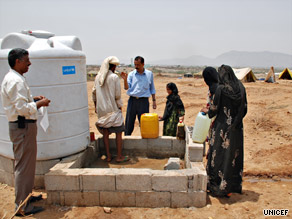
Women and children collect water earlier this month at camp in northern Yemen for those displaced by fighting.

Women and children collect water earlier this month at camp in northern Yemen for those displaced by fighting.

"We have been exercising strict precautions to minimize collateral civilian casualties and damage," said the spokesman, Mohammed Albasha.

Thursday's strike was meant to target Shiite rebels in Amran province, according to Yemeni government officials who spoke on condition of anonymity. Houthi Shiite rebels were fighting near the site, officials said.

Government officials put the death toll at 86, while UNICEF said "reliable" government and media sources put the death toll at 87 -- most of them women and children.

CNN could not independently verify those numbers, and the Yemeni government did not officially comment on the airstrike.

The U.N. high commissioner for human rights, Navi Pillay, on Friday called for an immediate investigation by Yemen's government.

"This is a deeply disturbing development in a conflict that was already troubling in terms of its impact on civilians," Pillay said. "The government should launch a full-fledged investigation into what went wrong, and take immediate measures to try to ensure we do not see a further avoidable tragedy of this nature."

Albasha said there were no registered camps for internally displaced people in the region where the strike occurred. He said there are claims from humanitarian organizations that Houthi insurgents may have used the civilians as human shields.

The rebels have set up roadblocks in the conflict zone, trapping civilians, Albasha added.

According to reporters from the Yemen Post who were on the ground nearby, regional tribes that support the government in the fight against the Shiite rebels withdrew from combat to protest the airstrike.

UNICEF on Thursday decried the high number of civilian casualties in the airstrike, without specifying how many civilians had died.

"UNICEF is deeply concerned about reports that civilians, including children, died in an air raid on a camp for displaced persons in northern Yemen," the statement said.

"This latest incident is a tragic development in an already alarming situation. More than a month after the latest escalation of fighting, children affected by the conflict still have no access to safe water, adequate sanitation, health care and protection."

The United Nations recently said fighting between Yemeni government forces and Houthi Shiite rebels in northern Yemen has displaced 150,000 people since the latest round of fighting began on August 12. This month, the United Nations appealed for $23 million in emergency aid to help Yemenis uprooted by war -- but so far, it has received not a single cent.

Battles between Yemeni forces and rebels in the north have raged intermittently for five years. A government offensive launched last month has escalated bloodshed.

The conflict is considered to be both separatist -- over who will assert authority in the area -- and sectarian -- whether Shiite Islam will dominate in majority Sunni Yemen. The rebels are supporters of slain Shiite cleric Hussein al-Houthi. Link...

External Affairs minister faces sacking for 'holy cow' remark

By Iftikhar Gilani

NEW DELHI: Shashi Tharoor appears all set to get the boot for "our holy cow" humour, not only from the government as the minister of state for external affairs but perhaps also from the Congress that he joined barely six months ago. Even though Prime Minister Manmohan Singh attempted to play down his comments saying, it was a 'joke', Tharoor's remark has left ruling party leaders seething with anger.
Although Tharoor apologised for his comments on his Twitter account on Thursday, it seems his apology has not made much of a difference.

Action:
Congress spokesman Manish Tiwari made it clear that the 53-year-old London born minister would face 'action'. Replying to questions at the All Indian Congress Committee press briefing, Tiwari said, "Appropriate action would definitely be taken at an appropriate time."
Rajasthan Chief Minister Ashok Gehlot's asking Tharoor to resign as minister was 'natural', as what he (Tharoor) did was "bound to have such a reaction," Tiwari asserted when asked to comment.
Tharoor's caused the furore when he promptly replied to a loaded question on Twitter by a pro-Bharatiya Janata Party journalist, asking him whether he would travel "cattle class" to Kerala that elected him to Parliament.
Tharoor, justifying his comments on Twitter, said he did not use the phrase "cattle class" but only repeated what the journalist wrote.
"It's a silly expression but means no disrespect to economy class travellers, only to airlines for herding us in like cattle," he wrote on his Twitter account.
Congress leaders insist that his Twitter dig at austerity is no humour but rather sarcasm at the party leadership cutting down wasteful expenditures in view of a difficult drought year.
In response to his remark being seen by Congress leaders as a veiled attack on Rahul Gandhi, Tharoor writes, "Holy cows are not individuals but sacrosanct issues or principles that no one dares to challenge. I wish critics would look it up."
In another tweet, Tharoor said he had been told his remark sounded worst in Malayalam when said out of context. "I now realise I shouldn't assume people will appreciate humour. And, you shouldn't give those who would wilfully distort your words an opportunity to do so," he added. Link...

FIR on what Hafiz Saeed said

ISLAMABAD: The two cases registered against Hafiz Saeed, founder-leader of the Lashkar-e-Taiba, by the Punjab police in Pakistan relate to speeches he made in Faisalabad on August 26 and 27 in which he glorified jihad as a war to be waged for and on behalf of Allah, and asked people to unite and participate in it wholeheartedly.

Both cases against Mr. Saeed have been made out under Section 11 F (4) of Pakistan’s Anti-Terrorism Act 1997, according to which “a person commits an offence [under the Act] if he addresses a meeting, or delivers a sermon to a religious gathering, by any means whether verbal, written, electronic, digital or otherwise, and the purpose of his address or sermon, is to encourage support for a proscribed organisation or to further its activities.”

Neither case is linked to the Mumbai attacks. One case has to do with a Koran preaching session at Royalton Hotel in Faisalabad’s Canal Road early on August 27. An estimated 2,500-3,500 of his followers had gathered for the sermon.

According to the FIR, he is said to have told the gathering that the mark of a good Muslim was “roza [fasting during Ramzan], jihad [holy war], namaz [prayers].”

Saeed said he was once asked by a non-believer what jihad was. His reply: “If a qaum [nation] has taken away what is yours, has occupied your land and suppressed your rights, what would you do? The blow struck by jihad does not come from man, it comes from Allah. He who Allah strikes in this manner cannot rise again. This is why the American economy is in the doldrums today.”

The FIR says donations were also collected from those present.

The other case relates to an iftar he attended at People’s Colony at Jaranwala Road on the evening of August 26. It was hosted by one of his followers, Chaudhary Nisar Ahmed.

Saeed is said to have spoken about the necessity of jihad at this gathering too. The United States, he said, had “staged” 9/11 to use as a pretext for invading Afghanistan and sending NATO troops there, but it had met with failure. Now they are active inside Pakistan.

“India also staged the Mumbai attacks and gave us the label of terrorists. India and Israel are together conspiring against Pakistan’s nuclear capability, but they too have failed in their agenda,” the FIR quotes him as saying.

India was now apprehensive of an American exit from Afghanistan, he said, “because [Indians] are involved in terrorist activities in the North-West Frontier Province and in Balochistan.”

Pakistan was paying the price, the FIR quoted Saeed as saying, for the “U-turn” the previous Musharraf regime and the present government had made on the Kashmir issue.

“The time has come to stand united and come forward to take part in jihad,” he said.

The registration of cases against Saeed under the Anti-Terrorism Act for speaking about jihad is an important step by Pakistan.

It appears to be a signal that Pakistan is willing to act against anti-India groups and to link their jihadi activities to terrorism, a change from the earlier stand that these were “freedom fighters” in the Kashmiri cause.

It is significant that the move came just before the planned meetings of the India-Pakistan Foreign Secretaries and Foreign Ministers on the sidelines of the United Nations General Assembly in New York.

With New Delhi insistent that “credible action” against Saeed would determine the meaningfulness of dialogue with Pakistan, and also giving a dossier to Islamabad on his alleged connection to the Mumbai attacks, plus getting Interpol to put out a red-corner notice for him in the case, the question in India is bound to be why the Lashkar-e-Taiba/Jamat-ud-Dawah leader was not booked in the Mumbai case.

Pakistan had indicated it was studying the dossier and at other times, that the information in it was not sufficient for it to take action against him.

But more than anything, it would be practically impossible for the Pakistan government, always mindful of accusations at home of bending to India’s will, to be seen acting against Saeed on New Delhi’s demand.

The booking of cases against the JuD chief unconnected to the Mumbai attacks is a fair indication of that constraint. Link...

Pak rangers, BSF meet after firing incident

Pakistani Rangers fired again at Border Security Force (BSF) personnel in the Akhnoor sector, 40 km from Jammu city, early on Friday morning.

Unlike Thursday’s firing by the Pakistanis in which two BSF jawans were injured, no one was hurt in Friday’s gunbattle.
Pakistani Rangers have however denied firing across the border. The denial came at a flag meeting between officers of the BSF and the Rangers after the firing on Friday.

“Early on Friday morning at about 6.45 am, Pak Rangers fired fresh rounds out an observation party. We also fired some rounds. The firing continued for a couple of minutes,” BSF Inspector General A.K. Saroolia told HT.

“There was no cutting or breaching of the fence. There were no ground signs suggesting possible infiltration. But it can’t be ruled out,” Saroolia said.

Jammu IGP Ashok Kumar Gupta did not rule out the possibility of terrorists having sneaked in. “There is a possibility of successful infiltration after firing on the BSF personnel,” he said.

Additional police parties have been deployed at various places in and around Jammu city. Special checkposts have been set up all along the 35-km Jammu-Akhnoor road. Link...

Pakistan needs better schools to beat extremism, says President

Pakistan needs $100 billion to fight terrorism, set up alternatives to radical islamic schools and repair its economy, President Asif Ali Zardari said yesterday in London.

“The world does not have the money,” he acknowledged, but he will still take his demand for urgent funds for education to a meeting with President Obama in New York next week.

“Years of dancing with the dictators has encouraged the crisis of today,” he said, blaming Pakistan’s former military rulers for sowing the seeds of violent extremism, and their backers in the West for tolerating them.

“I need at least $2 billion in educational support,” he told an audience, calling most pressingly for money to help drive back the Islamist teachers and their madrassas.

President Zardari, speaking at the International Institute for Strategic Studies, added that Benazir Bhutto, his late wife and twice prime minister, who was assassinated nearly two years ago as she campaigned for election, “would have done all this much better”.

He said that the radicalisation of children in Pakistan was “an ideological monster created by us sitting here in the free world”. “When my wife was Prime Minister there were not so many madrassas,” he said, adding that the schools were “created by very intelligent minds” for military purposes — fighting in Kashmir and on the Afghan border — and that they needed to be countered with better schools and colleges.

This theme was favoured by Ms Bhutto while she wss Prime Minister, although the achievements of her government lagged the rhetoric by some way.

Two of their three children came to the speech — Bilawal, now a student at Oxford University, in traditional Pakistani dress, and Asifa, one of two daughters, in an elegant jacket and black slacks.

Speculation has hovered over their ambitions for politics, given the magic of the Bhutto connection within the ruling Pakistan Peoples Party (PPP), but so far they stayed clear of any involvement.

Mr Zardari notably avoided criticism of operations by the US and other countries in Afghanistan, saying “We all broke Afghanistan together, let’s make it [right]”.

He also declined invitations from Pakistani journalists to say that General Pervez Musharraf, his predecessor as President, and now living in Bayswater, London, should be prosecuted.

In a display of statesmanship which his predecessors have not always managed, he avoided what he called “blame-gaming” towards India.

President Zardari will co-chair with Gordon Brown a meeting next Thursday in the wings of the UN General Assembly in New York, in which he will make another call for “market access to the countries of the European Union". Link...

Bomber kills 32 in pre-Eid carnage

PESHAWAR — At least 32 people were killed and 56 others injured when a suicide bomber rammed an explosives-laden car into a hotel in Ustarzai area in district Kohat on Friday.
In a latter development, three more persons were killed when some unknown assailants opened indiscriminate fire on the funeral of one of the victims of the blast.
The bomber blew himself up at a bazaar outside Kismat Ali hotel near a bus-stand in Usterzai locality apparently dominated by Shia community on Hangu Road that resulted in flattering the two-story hotel completely, killing 32 people and injuring 50 others. Besides, damaging 26 shops and 15 vehicles.
The dead bodies lay on the road and casualties were trapped under the debris from shops that caved in after the blast. Eyewitnesses said that several cars were destroyed while the intense blast brought down more than two dozen shops at the crowded market.
They said that the suicide bomber struck his explosive-filled car with other vehicles parked on the roadside. As the bomber blew himself up the whole buildings on both sides of the road caved in completely.
At the time of suicide attack, the area was packed with shoppers buying food and sweets for Eidul Fitr holiday likely to be celebrated on Sunday in the province. An eyewitness said that a suicide bomber blew up a car filled with explosives in the market, saying the attack occurred near a bus stop where passenger buses and coaches arrive and depart from other towns including FATA.
According to the bomb disposal squad, it was a suicide attack, in which the explosives-laden vehicle probably contained more than 150kg of explosives was used and the blast shook Kohat.
The rescue teams worked through the afternoon to pull victims from the rubble. Most of the injured are stated to be in critical condition and they were taken to Peshawar. Furthermore, emergency was declared at hospitals in Kohat. Soon after the explosion, Kohat-Hangu road was closed off for all sort of traffic. Link...

Pakistan balks at pursuing anti-U.S. extremist groups

Despite growing U.S. military losses in Afghanistan, Pakistan still refuses to target the extremist groups on its soil that are the biggest threat to the American-led mission there, the U.S. ambassador to Pakistan told McClatchy Newspapers.

Eight years after Washington and Islamabad agreed to fight the Taliban and al-Qaida, Pakistan has "different priorities" from the U.S., Anne Patterson said in a recent interview. Pakistan is "certainly reluctant to take action" against the leadership of the Afghan insurgency.

As the war in Afghanistan becomes more brutal - and as its political and popular support wanes in the U.S. - Pakistan's refusal to act in support of American goals is undermining the U.S. effort to deny al-Qaida and other extremist groups a sanctuary in Afghanistan.

The most effective Taliban fighters, the Haqqani network of veteran Afghan jihadist Jalaluddin Haqqani and his son Sirajuddin, operate out of the North Waziristan region of Pakistan's tribal territory. Taliban founder Mullah Mohammad Omar is widely thought to be based in the western Pakistani city of Quetta, from which he directs the insurgency through the so-called "Quetta Shura," or leadership council.

Experts on the Afghanistan war think that military progress and political stability won't be possible there unless the government roots out the havens the insurgents have established in western Pakistan. The International Institute for Strategic Studies, a London-based research center, concluded in its annual review this week that "Pakistan remained the biggest source of instability for Afghanistan."

Pakistani officials, however, say that their country's priority should be to tackle Islamic militants who threaten Pakistan. They charge that the U.S. is blind to Pakistan's concerns over traditional foe India as it presses Pakistan to redeploy forces from its eastern border with India to the western border with Afghanistan.

The disagreement between Washington and Islamabad was illustrated starkly this week when former President Pervez Musharraf acknowledged in a television interview that he'd diverted American military equipment that was meant to fight the Taliban in western Pakistan for use against India. "One doesn't care who one crosses," Musharraf told Pakistan's Express News.

In testimony Tuesday before Congress, the chairman of the Joint Chiefs of Staff, Adm. Michael Mullen, said: "The Pakistani military ... consider their principal threat - their existential threat - to be Indian, not these extremists."

The U.S. has lavished praise on the Pakistani army for the offensive it launched in April against Taliban militants in Pakistan. The operation marked the first serious sign of determination to deal with armed extremists, but it hasn't extended to groups in Pakistan that fight exclusively in Afghanistan. Mullen said that Pakistan's recent anti-terrorism actions "had a big impact" although "it hasn't been perfect."

While Pakistan and the U.S. agree on targeting al-Qaida and, more recently, the Taliban Movement of Pakistan ("Tehreek-e-Taliban Pakistan"), they strongly disagree over action against Afghan insurgents operating from Pakistani territory.

"Where we differ, of course, is the treatment of the groups who are attacking our troops in Afghanistan. And that comes down to Haqqani and Gul Bahadur and Nazir, to a lesser extent Hekmatyar, and yes, of course, there are differences there," Patterson said, naming some of the most prominent extremist leaders. "We have a very candid dialogue about this with some frequency." Link...

SHC dismisses urgent plea on sugar price

Karachi: Sindh High Court dismissed application for urgent hearing of a petition that sought court injunction for selling sugar at the retail price of Rs40 per kilogram.

The court observed that there is no urgency to entertain the petition as the matter is already seized in Supreme Court. Petitioner Maulvi Iqbal Haider challenged that sugar price in the province, which is being sold at more than Rs50 per kg despite the order of Lahore High Court that fixed the retail price of sugar at Rs40 per kg.

He submitted that All Pakistan Sugar Mills Association and Sindh Sugar Dealers Association had stocked more than 2 million tons sugar but they were not releasing the commodity for general public owing to low profit, saying, during the beginning of this year the ex-mill price was more than Rs28 per kg. He said that prior to the advent of Ramzan the respondent dealers had concealed sugar with mala fide intention just to take extra profit from the general public and suddenly sugar prices rose up to Rs.45 per kg throughout the country, which was a clear violation of Competition Commission of Pakistan Ordinance.

The petitioner submitted that Supreme Court upheld the judgment of Lahore High Court regarding fixation of Rs40 retail price for sugar and the said order should be implemented in entire Sindh in letter and spirit forthwith, as the people of Sindh were purchasing sugar at more than Rs50 per kg. After conducting preliminary hearing of the petition, the court observed that there is no urgency in the petition as the matter has also been taken up by Supreme Court, and dismissed the application for urgent hearing.

Petition against irregularities in Revenue Department: Sindh High Court called comments from Advocate General Sindh on a petition against irregularities in Revenue Department.

Employees of Revenue Department sent a letter to chief justice regarding the appointment of Mukhtiarkars in violation of rules and regulation. Petitioners submitted that the Mukhtarikar posts are being filled through direct appointments without Sindh Public Service Commission’s test. The court converted the letter into petition and issued notice to AG for comments.

Petition against harassment: Sindh High Court issued notices to Advocate General Sindh on the petition of a woman against harassment of her family. Ms. Ayesha submitted that she converted to Islam and married Salman Baloch on August 28 but her family members being annoyed with the marriage registered a case against her spouse at Thatta police station. She prayed the court to quash the criminal proceedings as she has married out of her freewill. The court, issuing notice to AG, restrained police from taking coercive action against the couple.

KPT land case: Chief secretary filed his affidavit on government appeal against the order regarding lifting of ban on sub-lease and transfer of 130 acres land in Mai Kolachi area, submitting that the appeal was filed with his consent.

The court was hearing the appeal filed by Land Utilization Department, Board of Revenue against the single judge’s order.

The appellant submitted that single judge of SHC vacated the stay on disputed 130 acres land, allowing KPT Officers Housing Society to sub-lease and transfer as well as mutation of land merely in the light of minutes of chief secretary despite the fact that chief minister’s approval was not obtained for doing so.

Sindh government submitted that impugned order was based on undertaking in terms of minutes and it has prejudiced the case of appellant as the question of land ownership is yet to be decided and respondent will create third party interest due to modification in the status quo order of the land in question.

The court was prayed to set aside the single bench’s order and restore the status quo position of the land. SHC’s division bench comprising Justice Mushir Alam and Justice Mohammad Athar Saeed, after taking the affidavit on record, adjourned the hearing till Oct 10. Link...

Musharraf’s trial may backfire: Shujaat

By Asim Yasin

ISLAMABAD: President Pakistan Muslim League-Quaid (PML-Q) Chaudhry Shujaat Hussain Friday ruled out the possibility of trial of General (retd) Pervez Musharraf under Article 6 of the Constitution saying that those who would initiate it could also be tried under the same article.

“If General (retd) Pervez Musharraf is tried, all those who will initiate it will also come under the same article,” he said while talking to newsmen at the Iftar dinner hosted by him here at his residence.

When sought his comments on the recent statement of Musharraf in which he confessed his mistake of removing Chief Justice Iftikhar Muhammad Chaudhry, he said if Musharraf admitted this mistake, he should also admit his other mistakes.

Shujaat Hussain came hard on the PPP and the PML-N, saying that one party was ruling the country while the other was chasing the red light with the assumption that its term to rule would come. “Both the parties stand exposed before the people and failed to deliver,” he remarked.

When asked whether he foresaw mid-term polls in near future, Chaudhry Shujaat rejected the notion saying his party would oppose any such option and would let the federal government complete its due period of five years.

He said it was in the interest of the democratic process that the coalition government should complete its term so that it might have no excuse of failure. “We would not let the government take advantage of any mid-term elections on the pretext that they were deprived of their five-year term,” he told the journalists.

Shujaat said he would embark upon a countrywide visit and would make the people aware of the state of affairs. He said that the Americans had taken residential houses in Islamabad and even got a residential house adjacent to his house. He said the foreigners were allowed to come in Islamabad without holding any valid documents. Link...

Pakistan, China agree to develop new satellite

ISLAMABAD: Pakistan and China signed an agreement on Friday to develop a new satellite, PAKSAT-1R, in about three years period, Pakistan's Economic Affairs Division (EAD) said in a press release.

According to the framework agreement signed by EAD Secretary Farrakh Qayyum and Chinese Ambassador to Pakistan Luo Zhaohui, China will fund the satellite project with a soft loan of 1.35 billion RMB (about $200 million) carrying maturity period of 20 years.

The communication satellite will have 30 years transponders, 12 in C-Band and 18 in Ku-Band, each of 36 MHz Bandwidth. The program is in line with Pakistan's Medium Term Development Framework (MTDF 2005-10) objectives and may provide better satellite communications for Pakistan, said the press release.

Pakistan Space and Upper Atmospheric Research Commission (SUPARCO) and China Great Wall Industry Corporation (CGWIC) will jointly develop the new satellite to replace the Pakistan Space Craft, which is likely to expire in 2011. Link...

Gilani forwards 10 names for SHC

The PM Gilani sent a summary to the President Zardari advising him to appoint 10 additional judges selected from a list of 21 nominees.—Photo by Reuters

ISLAMABAD: Prime Minister Yousuf Raza Gilani sent a summary to President Asif Zardari on Friday advising him to appoint 10 additional judges of the Sindh High Court (SHC) selected from a list of 21 nominees.

The prime minister approved the appointment of Shahid Anwar Bajwa, Rukhsana Ahmed Malik, Ghulam Sarwar Kurai, Ahmed Ali Sheikh, Ali bin Adam Jaffery, Bhajandas Tejwani, Irfan Saadat Khan, Aqeel Ahmed Abbasi, Muneeb Akhtar and Tufail H. Ebrahim.

The names were approved despite concerns expressed by some senior lawyers who were in the forefront of the movement for restoration of the judiciary, including SHC Bar Association’s president Rasheed A. Razvi who is a former judge of the court.

Mr Razvi had said recently that names of eminent individuals and former judges Arshad Siraj Memon and Salman Ansari should be included in the list.

Mr Memon and Mr Ansari were appointed judges of the SHC on Sept 15, 2007, on the recommendation of then SHC chief justice Sabihuddin Ahmed with the concurrence of Chief Justice of Pakistan Iftikhar Mohammad Chaudhry.

They had refused to take oath under the Provisional Constitution Order (PCO) proclaimed on Nov 3, 2007.

The SHCBA president had dismissed a perception that the association had been consulted before the names were recommended by the chief justice of the high court to the Sindh governor for appointment.

After the July 31 judgment of the Supreme Court about PCO judges, the president had unseated 20 judges of the SHC appointed on the advice of former chief justice Abdul Hameed Dogar.

A senior lawyer told Dawn that Mr Bajwa practised on the labour side. Rukhsana Malik worked as a junior with Advocate Talmeez Barni.

Mr Kurai and Mr Tejwani belong to Sukkur. Mr Tejwani has served as president of the Sukkur Bar Association and is said to be close to former SC judge Rana Bhagwandas. Link...

Settlement of Kashmir, Palestine vital for peace: Al-Moosvi

SRINAGAR (IHK): In occupied Kashmir, senior leader of the All Parties Hurriyet Conference (APHC), Agha Syed Hassan Al-Moosvi has said that the settlement of Kashmir and Palestine disputes is imperative for durable peace in the world, reports KMS.

Addressing the Juma congregation on the occasion of Yaum-i-Kashmir and Yaum-i-Quds at Badgam, Agha Hassan said that the occupation forces in Kashmir and Palestine had made lives of the people miserable. He said that Kashmir was internationally recognised disputed territory and the people of Jammu and Kashmir had raised the dispute at international forums.

He maintained that Indian troops wanted to suppress the voice of Kashmiris through use of brute force but they wouldn’t succeed in their nefarious designs.

The APHC leader urged India to give up its rigid stance on Kashmir and come to the negotiating table in the larger interest of the people of South Asia so that permanent peace could be established in the region. He also demanded of the world community to put pressure on New Delhi to resolve the dispute in accordance with Kashmiris’ aspirations.

Meanwhile, the people in Srinagar, Sopore, Baramulla, Bandipore, Ganderbal, Charar-e-Sharief, Islamabad, Kulgam, Shopian, Tral, Thanna Mandi, Sarankot, Poonch, Kishtwar, Doda, Bhaderwah, Mandher and other cities and towns held massive protest demonstrations on Jumatul Wida, which was observed in occupied Kashmir as Yaum-i-Kashmir and Yaum-i-Quds. The demonstrators raised high-pitched slogans against India and in favour of liberation of Kashmir and Palestine. Link...

Rehman Malik reviews law, order situation

ISLAMABAD, Sep 18 (APP): Interior Minister Rehman Malik here on Friday chaired a high level meeting to review law and order situation in the country. The meeting was attended by Secretary Interior Qamar Zaman Chaudhry and representatives of other law enforcement agencies.

Rehman Malik said all-out efforts would be made to ensure foolproof security arrangements to protect life and property of the citizens, said a press release issued here Friday.

The meeting also discussed various issues including presence of foreigners in the capital and acquiring rental accommodation by them.

Meanwhile, a chinese delegation led by Chinese ambassador to Pakistan Luo Zhaohui called on Interior Minister Rehman Malik. The meeting held in a cordial atmosphere in which matters of bilateral interest came under discussion.

Rehman Malik said Sino-Pak friendship is all-weather and time-tested, adding “China is a trustworthy friend of Pakistan.” He said both the countries would further enhance bilateral cooperation in diverse fields.

Secretary Interior Qamar Zaman Chaudhry was also present in the meeting.

The Chinese ambassador said China give special importance to its relations with Pakistan and expressed strong conviction that in future these relations would be further strengthened.

Another meeting was held under the chairmanship of Rehman Malik in which the issue of kidnapping of a Greek citizen was discussed. The minister directed the concerned officials to make all out efforts to recover the abductee. Link...

7 terrorists apprehended, 11 surrender: ISPR

Rawalpindi: Seven terrorists have apprehended while 13 surrendered themselves before the security forces during Search and clearance operations in Swat and Malakand.

According to ISPR 11 terrorists voluntarily surrendered to security forces at Guljabba, Hazara near Kabbal and Shalhand.

2 terrorists voluntarily surrendered to security forces at Derai Sar near Chuprial and Aloch Bazar. Security forces apprehended 7 terrorists at Cahrbagh, Udigram, Malam Jabba and Gulibagh. Link...

No deal with Musharraf for his safe passage: PM Gilani

ISLAMABAD, Sep 18 (APP): Prime Minister Syed Yusuf Raza Gilani on Friday categorically rejected the perception of any secret deal with former President Pervez Musharraf to give him safe passage. “If there had been such a deal it would have come forth by now as media is very vibrant today,” he said in an interview with Samaa television channel.

He said President Musharraf’s actions have not been indemnified by the parliament nor he has been convicted so there is no question of him being pardoned.

The Prime Minister said that the remarks attributed to President Zardari in this regard have already been contradicted by the Presidency.

Replying to a question about three ‘deals’ in the past with Pervez Musharraf, involving Nawaz Sharif and Shaheed Benazir Bhutto and President Zardari, Gilani said as far as the deal with Nawaz Sharif is concerned he did not consider it a deal as the PML (N) leader at that time was under custody.

“If a person is in custody, legally it cannot be considered a deal. Confession before a police officer is no confession.”

He said negotiations between Benazir Bhutto and Pervez Musharraf were going on for the former President to doff off his uniform and for holding free and fair elections.

However, he added, there were many conditions which were not fulfilled and emergency was imposed after which Benazir contacted party leadership and decided to go for a long march.

The Prime Minister also referred to attack on Benazir Bhutto on the very first day of her arrival in Karachi adding she was later assassinated during an election rally in Rawalpindi.

He said after PPP came into power, they started putting pressure on Musharraf and the provincial assemblies passed unanimous resolutions for his resignation and later planned to go for his impeachment.

To a question the Prime Minister said that Musharraf’s well wishers may have advised him to quit honourably.

He said had the former President the support of judiciary or the army, he would have never resigned.

He said when President Zardari and Nawaz Sharif were holding a press conference to declare Musharraf’s impeachment, he was supposed to go to Beijing Olympics but was delaying his plans to go to China.

Finally, he called off his tour but the Foreign Office said one of the two should go in view of Pakistan’s relations with China.

“Musharraf had the hanging sword of impeachment while I had the hanging sword of 58 (2)b, But I decided to go to China.”

He said the President had consulted informally with his political aides and with common friends about using 58 (2)b against him.

“He would say that I had many options and this (58 ) was one of them.”

About using article 6 of the constitution against Musharraf for holding his trial, the Prime Minister reiterated that he was for it if there is a unanimous resolution of the parliament.

He, however, said that his government is a blend of political parties and people who had been with President Musharraf and he also wants to take along the allied parties.

“I am for it. We must create a history. But at the same time we should not rock the boat. If there is a unanimous resolution then the whole nation would be together.”

He said he suffered at the hands of Musharraf regime as he remained in jail for five years during which his sister and mother died. “Emotions and politics are two different things. I have to think about country.”

To a question about Balochistan he said, under a package which includes constitutional, administrative and economic reforms, is currently being prepared under constitutional amendments after which the people of the province would be satisfied.

He said he has already started taking allied parties into confidence over these reforms.

“If it is taken to the joint sitting of the parliament for approval where it is defeated, then nothing will be achieved.”

“We have to implement this package as we don’t want to play before the galleries.”

He said this package will set a direction towards greater provincial autonomy.

About the issues of governance, Prime Minister Gilani said it is the responsibility of the government to resolve them.

He said the biggest challenge to the country is terrorism, elimination of which is priority number one of his government and stressed that no war can be won without the support of the nation.

“The parliament has supported us whole heartedly on this war against terrorism and I am grateful to the leadership of all political forces.”

He asked a counter question whether the current operation against the militants is successful or the one carried out in the past.

He paid tributes to the armed forces, police personnel and all those who laid down their lives in successful operation against militants in shortest possible time.

Prime Minister Gilani also highlighted the excellent handling of IDPs and their safe return to homes immediately after the army operation.

About extending army operation into other troubled tribal areas he said his strategy is not to move alone but take all stake holders along.

He said when time comes he will take all the political as well as military leadership into confidence and “see whether it is worth it or not worth it but I will not disclose it earlier.”

Replying to a question about changes in bureaucracy he said it is a continuous process.

He said he has worked with President Musharraf for six months and no minister or secretary would meet him without first taking him (Gilani) into confidence.

He said contrary to the general impression, he enjoys all the powers of the chief executive as without his consultation and advice, the service chiefs or judges of superior judiciary cannot be appointed and he is the one who has the authority to make changes in bureaucracy.

Prime Minister Gilani said that President Zardari has a unique position as he also heads a party and his position is much better than Pervez Musharraf. Therefore, he added, he cannot use 58 (2)b given that there is so much of judicial activism which will never allow such an action.

He said he personally went to Mian Nawaz Sharif in Raiwind to make Charter of Democracy as base for reconciliation to which he agreed. A constitutional committee has been formed in this regard which, he hoped, will soon complete its work.

The decision of the committee on constitutional amendments including 17th amendment and 58 (2)b will be followed, he assured.

The Prime Minister said there was judicial activism and media activism in the country and they are in the process of evolution and things will be stable with the passage of time.

Replying to a question about ‘minus one formula’ and mid-term elections, he said there is no minus one formula in democracy and the rest of the discussion is unnecessary and he has stopped the party people from discussing these issues.

He said immediately after he was elected as the leader of the house, he unveiled his party’s manifesto and later got its approval from the cabinet. He said he was satisfied with his government’s performance over the last year and a half given the unfavourable conditions in which he took reigns of power. “It can’t be better.”

He vowed that good governance will be his priority and said to check corruption there were three tiers including judiciary, which can take suo moto action, Public Accounts Committee and Auditor General of Pakistan.

To a question about relations with the US, the Prime Minister said Pakistan-US has a long history of cooperation in defence, intelligence and education etc. and the government wants to further enhance these relations.

About the reported leasing of land to some Arab countries for intensive farming, Prime Minister Gilani said these will be given if they agree for corporate farming and construction of dams.

He made it clear that it does not mean selling Pakistani land and added that Pakistan bought Gawadar when his father was a federal minister in Feroze Khan Noon’s cabinet. Link...

NYMEX-Crude ends down as dollar up, products dip

 NEW YORK, Sept 18 (Reuters) - U.S. crude oil futures ended
lower on Friday, pressured by a stronger dollar and as refined
product futures fell after gaining for two days.
 "After being up for much of the week the market took a
slight breather today and the dollar was able to show some
strength," said Tom Bentz, analyst at BNP Paribas Commodity
Futures Inc.
 The dollar rebounded from a one-year low against the euro
as waning risk apetite cut demand for higher-yielding
currencies and raised demand for the greenback. [USD/]
 Heating oil and gasoline futures buckled down under the
weight of slack demand and after inventory reports earlier this
week showed that product inventories rose last week.
 In the past two days, refined product futures exhibited
strength as traders focused on autumn refinery maintenance that
could curb heating oil and gasoline production.
 Support from equities waned, though oil traders were
watching closely and even as Wall Street rose after some
brokerage upgrades. [.N]
 "The financial backdrop, with rising equity markets and
concerns about the U.S. dollar, continues to dominate the
day-to-day price swings," said Tim Evans, energy analyst at
Citi Futures Perspective.
 "At the same time, though, we note that the underlying
fundamentals are telling a different story, with elevated
inventories (especially in the distillates markets) and OPEC
responding to the rising price this year by slowly increasing
output...," Evans noted.
 PRICES
 * On the New York Mercantile Exchange, October crude CLV9
settled down 43 cents, or 0.59 percent, to $72.04 a barrel,
trading from $71.27 to $72.66. For the week, the contract
gained $2.75, or 3.97 percent.
 * In London, November Brent crude LCOX9 setled down 23
cents, or 0.32 percent, at $71.32 a barrel, trading from $70.51
to $71.79.
 * NYMEX October RBOB RBV9 ended down 1.88 cents, or 1.02
percent, at $1.8324 a gallon, trading from $1.8220 to $1.8534.
 * NYMEX October heating oil HOV9 finished 1.30 cents
lower, or 0.71 percent, at $1.8279 a gallon, trading from
$1.8178 to $1.8484.
 * The October/October RBOB crack spread <0#rb-cl=r> ended
at $4.92, down from $5.28 on Thursday. The October/October
heating oil crack spread <0#cl-ho=r> ended at $4.73, dipping
from $4.85 on Thursday.
 * The spread between the current front month and the
five-year forward crude contract CLc61 ended at $13.26,
widening from $12.91 on Thursday. The October 2014 contract
settled on Friday at $85.30, down 8 cents, or 0.09 percent.
 TECHNICALS
 NYMEX crude 10-day/20-day moving average: $70.83/$70.96
 Technical support/resistance:
 NYMEX crude: $70.00/$75.00
 NYMEX heating oil: $1.7856/$1.85
 NYMEX RBOB: $1.82/$1.90
 For a full report on technicals, click on [ID:nLI684769]
Link...

NFC compelled to evolve new formula to measure GDS

By Khalid Mustafa

ISLAMABAD: The unwavering support extended by Punjab and NWFP to Balochistan on the issue of gas development surcharge (GDS) compelled the National Finance Commission Friday to evolve new formula to measure GDS. Finance minister Shaukat Tarin, who chaired the NFC meeting, has constituted a sub-committee to furnish recommendations to resolve the issue by October 12, a senior official who attended the meeting told The News.

Balochistan wants NFC to abandon the existing proportionate gas cost production formula to determine the GDS and demands that it should be based on 50 percent on proportionate gas cost production and 50 percent on GDS production based on weighted average wellhead price of the province and weighted average sale price.

If the new formula as demanded by Balochistan is implemented then for the current fiscal, the country will have Rs16 billion as GDS. This will enhance Balochistan’s share from the current Rs3.5 billion to Rs7.5 billion.

Qaim Ali Shah, chief minister Sindh told reporters after the meeting that decision on gas development surcharge might not be a consensus one and in case no settlement is reached between Balochistan and Sindh, the chairman NFC will decide the issue on his own.

He said that Sindh is producing about 72% of natural gas and transportation charges are low because the manufacturing units are located near Mari gas and Kundkot gas fields.

Mr Shah also confirmed that a broad decision has been taken that the provinces where natural resources have been found will benefit the most. He was of the view that the federal government has resolved the issue of net hydel profits while the issue of GDS is being resolved. He said GST on services is not a complicated issue.

Tanvir Ashraf Kaira, finance minister Punjab, told reporters that GST on services was not discussed in the meeting due to time limitation; however, to settle the issue of gas development surcharge a committee has been formed with representation from all the four provinces. Punjab and Balochistan have stressed the need for judicious resource distribution under the new formula.

The meeting was basically scheduled to listen to the opinion of the constitutional and legal experts to assess whether the issue of GST on services falls in the jurisdiction of the centre or provinces.

“The secretaries committee is finalising expenditures benchmarking and vertical resource distribution recommendations,” Tarin said. “This report is to be tabled in the next NFC meeting where total resource availability will be determined. The federal as well as provincial shares will also be decided.”

“The centre has a major portion of expenditures on debt servicing, defence and subsidies and the consultations with provinces are going on to decide whether the centre should continue to incur these expenditures alone or share them with the provinces,” Tarin added.

Due to time limitation and lengthy debate on GDS issue, the remaining agenda items were deferred till the next meeting of NFC at Quetta on October 12-13.

Finance minister Shaukat Tarin said a sub-committee consisting of technical members has been set up to settle GDS issue. Secretary petroleum, chairman OGRA, and representative of finance ministry would be members of this committee, he told.

The committee would review GDS formula, work out its recommendations and present them in the next meeting of NFC. He said the NFC would hold its meetings regularly so that the award could be given final shape as soon as possible.

“We want to move forward on the NFC issue in a manner that all the provinces must feel that they are being treated on equal basis and justice is being done to them,” added Tarin.

The minister hoped that all the major issue like GST on services, GDS, vertical and horizontal distribution of financial resources as well as other items mentioned in terms of references (TORs), which are still to be finalised, would be settled in seven to eight meetings.

Tarin said Sindh has its reservations over centre’s views on GST on services and independent international experts will be consulted in this regard. He said that Balochistan has not tabled its demand for Rs300 billion as gas royalty and GDS arrears.

Mir Asim Kurd, finance minister Balochistan termed the setting up of sub-committee on GDS as major development and hoped that this would help resolve the issue. He informed reporters that Balochistan has asked the federal government to clear Rs150 billion GDS arrears and Rs150 billion gas royalty arrears.

Humayun Khan, finance minister NWFP did not respond to the question on NEPRA’s presentation on determination of net hydel profits in the future. He too expressed satisfaction over setting up of a sub-committee on GDS. Link...

ADB to provide $780 million for energy efficiency programme

ISLAMABAD: The Asian Development Bank (ADB) is extending $780 million to the country through a multi-tranche financing facility for energy efficiency projects that will help cater to the country’s growing energy needs and reduce its reliance on costly fossil fuels.

The $1.18 billion Energy Efficiency Investment Programme underpins Pakistan’s first-ever initiative to make both the pursuit of energy security and low-carbon growth a single strategic priority.

The 10-year programme puts energy efficiency and adoption of clean technologies at the heart of government planning and public investments, said an ADB press release received on Thursday.

Assistance: The multi-tranche financing facility will aid short to medium-term energy efficiency projects, including the replacement of incandescent light bulbs with more efficient and cost-effective compact fluorescent lamps.

The facility, which will release funds in tranches, will provide for a portion of the government’s 10-year energy efficiency investment plan, estimated at $3.8 billion.

Targeted energy savings under the programme will reduce the country’s energy intensity, while cutting greenhouse gas emissions by an estimated 30 percent.

The overall gains in annual savings by 2019 are expected to be around $4 billion and would provide major social benefits, such as increased household incomes, jobs, and reduced poverty levels.

The programme will help the government reduce public expenditures and subsidies, easing the debt problem in the power sector, which has weighed on attempts at improvements in the past.

Projects in the programme are also expected to be eligible for earning carbon revenues under the Clean Development Mechanism of the Kyoto Protocol.

Punjab loan: Also, the ADB on Thursday signed an agreement to loan $150 million to the Punjab Government Efficiency Improvement Programme – sub programme 2.

The main objectives under the Punjab Government Efficiency Improvement Programme are: (i) to improve financial management (ii) contingent liability management (iii) improving civil service management and (iv) private sector participation.

The programme aims at integrating top down strategic resource allocation and button an output based budgeting and broadening the tax base and improving tax administration. Link...

KSE hits 13-month high ahead of Eid holidays

KARACHI: The last session of Ramazan proved to be a boon for the Karachi bourse as investors ignored the high risk present there and accumulated bulk of stocks ahead of Eid holidays.

With another sharp increase of 2.31 per cent or 213.43 points on Friday, the KSE 100-share index jumped to a 13-month high at 9,436.80 points. This is the highest closing level after August 26, 2008 when the market ended at 9,430.29 points.

The parallel running junior 30-share index also surpassed the 10,000 points threshold successfully on massive price-hike and closed at 10,146.21 points, booking another gain of 2.11 per cent 210.15 points in this session.

The leading banking, exploration & production, oil marketing and telecommunication stocks altogether gave gains in the indices at the bourse. Notably, National Bank, MCB Bank, Habib Bank, United Bank, Oil & Gas Development Company, Pakistan State Oil and Pakistan Telecommunication Company; each of them contributed points to indices in double digit, in range of 10-43 points.

Analysts said the landing news of further recovery in the local economy, along with receding of world economic recession and particularly in Asia, kept equity investors booming, blooming and blossoming at the bourse.

Further increase in foreign exchange reserves of the country above $14 billion at current and turning of current account deficit into the ‘surplus’ in the single month of August-2009 at $82 million pushed up market to new height.

The foreigners grave interest in local markets also remained one of the leading factors behind lifting of market to this high. The offshore investors, therefore, injected another smart tranche of $7.78 million in this single session at local bourses, according to NCCPL, and continued to increase their margin of holdings here.

Analyst Ahsan Mehanti said rise in urea & DAP off-take by 42 per cent on yearly basis; rising foreign exchange reserves; high international crude oil prices; rising global equity markets; continuing foreign interest in banks, oil and fertilizer scrips and last but not the least the resolution of circular debt issue played a catalyst role in positive activity on the Karachi bourse.

The resolution of circular debt kept the oil marketing companies (OMCs), refineries and Independent Power Producers (IPPs) shining here at the local bourses, he added. Handsome gain in shares prices also helped the market generate slightly hither turnover on the board at 244.56 million shares.

This is 10 per cent higher than 222.19 million shares changed hands yesterday.

In accordance with the overall market performance, the overall market capitalisation surged by another Rs45 billion and stood at Rs2,727 billion. Analyst Hasnain Asghar Ali said as “we get closer to the announcement of next monetary policy,” the relaxations likely to be offered to the banking industry in this, continued to invite renewed buying interest. Leading from the front was the banking sector, while the major beneficiary of likely settlement of circular debt issue after initial off-loading continued the spree of hitting upper circuit, he said.

Investment companies stayed sentiment booster as well as contributed substantially to the turnover. The oil and gas exploration stocks continued to face off-loading mainly by the local participants. Sell-off, however, failed to have an impact as the other sector stocks banking, fertilizer and textile kept the activity alive, Ali further said. Out of total 365 actives, 254 stocks advanced, 87 stocks declined, while the value of remaining 24 stocks remained unchanged.

Highest volumes were witnessed in JS Company at 30.89 million closing at Rs30.53 with a gain of Rs1.45, followed by AH Securities at 13 million closing at Rs40.42 with a gain of Rs1.75, Pakistan Telecommunication Company at 12.442 million closing at Rs21.21 with a gain of Rs1.01, National Bank at 12.28 million closing at Rs84.23 with a gain of Rs3.77, and Pak.PTA at 10.54 million closing at Rs5.38 with a loss of 14 paisa. Link...

More stories coming soon...


D I S C L A I M E R :

Clarification: All of the contents provided on worldnewskhi.blogspot.com are hyperlinks. NO story are created or produced by us. Our job here is to provide simple hyperlinks and easy guidance for users to find stories on single page. We DO NOT create News here! If you find any content that is violating the copyright law, please send an email to naveed4pkk@gmail.com