US demands urgent action in Quetta

Mr Feierstein said the US believed that Al Qaeda chief Osama bin Laden was hiding in Pakistan’s tribal areas.— Photo from AP/File

ISLAMABAD: The United States stepped up pressure on Pakistan on Thursday, asking it to dismantle what a US embassy official described as Taliban’s command structure in Quetta, commonly known as the Quetta Shura, for the sake of securing peace in Afghanistan.

The diplomat did not rule out use of drones against what he called Quetta Shura.

‘In the first instance, we will like the government of Pakistan to move aggressively to prevent the use of Pakistan’s soil (by Taliban) in this way… we hope the GoP will take steps to arrest these individuals,’ US deputy chief of mission Gerald Feierstein told journalists.

He said action against the Quetta Shura was imperative for stabilising the situation in Afghanistan.

He insisted that Taliban leader Mullah Omar was in Quetta along with other senior leaders and operated freely. ‘They move around, sometimes they go to Afghanistan, sometime to elsewhere in Pakistan, but fundamentally they are in the area.’

When asked repeatedly if the US would launch drone attacks against Taliban targets in Quetta, he said predator issues were not discussed in public and that the focus was currently on getting cooperation from Islamabad for addressing the issue.

The statement is probably the harshest criticism of law-enforcement agencies to date by a US diplomat. The issue was previously referred to by the Americans only as a passing remark, or was attributed to unnamed officials because of intelligence and diplomatic considerations.

Analysts believe that the US is gradually building up pressure. The International Security Assistance Force’s Commander in Afghanistan, Gen Stanley McChrystal, in his recent assessment report to President Barack Obama said that the Taliban leadership in Quetta was behind a surge in violence in Afghanistan where July and August were the deadliest months for US troops in the eight-year war. Earlier this week, US Ambassador Anne Patterson had said that the Quetta Shura was high on American agenda.

Mr Feierstein referred to Gen McChrystal’s assessment and said everybody understood that part of the problem was in Balochistan.

The Kerry-Lugar bill on aid passed by the Congress on Wednesday and now awaiting President Obama’s approval requires the US secretary of state to certify that Pakistan has dismantled terrorist bases in Quetta.

But no one in Pakistan expected the US to launch such a tirade against Pakistan.

Before his trip to the US, President Asif Ali Zardari had been cautioned in a policy document that an orchestrated campaign had been launched by the US to shift the focus away from Afghanistan to Pakistan as the epicentre of terrorism.

Americans believe that the top Taliban leadership is present either in refugee camps or in the Afghan neighbourhoods of Quetta. US intelligence official believe that Mullah Omar collects funds and dispatches fresh fighters and weapons from his Quetta base.

Mr Feierstein rejected Pakistan’s position that the Quetta Shura was an outdated concept with most of its members having been killed or arrested. He said new people had replaced them and the ‘issue remains there.’

When asked if the government had accepted Washington’s demand for action against the Quetta Shura, he said: ‘It is a matter of ongoing discussion.’

The US diplomat appeared to be sympathetic towards the difficulties Pakistan could face in cracking down on Taliban’s alleged network in Quetta. ‘There is no confusion on our part that it is an easy or simple task.’

He said the American leadership was very clear that fixing the problem in Pakistan would not end the imbroglio in Afghanistan. However, he insisted that elements of the crisis could be addressed by Pakistan’s action against Taliban.

Responding to a question about allegations of Taliban sympathisers in Pakistan’s intelligence network, he said: ‘Are there individuals who have sympathies with the Taliban? That is fairly established that this has happened, certainly we have seen it.’

The issue is one of major western concerns and believed to be the cause of poor intelligence on the Quetta Shura.

However, the US official categorically stated that ISI as an institution did not support Taliban.

He revealed that some of those sympathisers had been arrested by Pakistani authorities.

Foreign Office spokesman Abdul Basit dismissed Mr Feierstein’s claim as baseless speculation and asked the US to come up with proof of Taliban’s presence in Quetta.

Defence analyst Brig (retd) Shaukat Qadir said the Americans were losing the war and were trying to find excuses. ‘Some time back I went to Quetta where both Baloch and Pakhtuns told me that Taliban did not exist in the city.’

Mr Feierstein also said the US believed that Al Qaeda chief Osama bin Laden was hiding in Pakistan’s tribal areas.

He questioned President Zardari’s claim made last month that Osama was dead, saying he was very much alive.

However, he said that Al Qaeda chief’s operational capacity was severely restricted because of action against his group. He said he doubted if Osama was still in charge of Al Qaeda’s day to day affairs. Link...

Obama: Iran must follow through on nuke promises

Saeed Jalili, general secretary of Iran's Supreme National Security Council and the country's chief nuclear negotiator, talks to SPIEGEL about Iran's nuclear program, the prospects for this week's talks in Geneva and why Iran is not afraid of new sanctions.

SPIEGEL Interview with Iran's Chief Nuclear Negotiator
Iran's top nuclear negotiator Saeed Jalili stands in front of a picture of Geneva's fountain at the... Expand
(Dominic Favre,Pool/Keystone/AP Photo)

WASHINGTON — President Barack Obama on Thursday called landmark nuclear talks with Iran a constructive beginning, then challenged Tehran to match words with deeds by giving international inspectors "unfettered access" to a previously secret uranium enrichment plant within two weeks.

"Talk is no substitute for action," Obama said at the White House after talks ended earlier in the day in Switzerland. "Our patience is not unlimited."

If Iran fails to live up to its promises of cooperation, "then the United States will not continue to negotiate indefinitely and we are prepared to move toward increased pressure," the president warned. His reference to pressure was an allusion to tougher U.N. and other sanctions already under discussion.

But Obama said that if Iran follows through with concrete steps "there is a path to a better relationship" with the United States and the international community.

"Going forward, we expect to see swift action," Obama said. Several times he called on Iran to take "concrete steps," signaling his intention to keep pressure on Iran until it follows through on promises.

Obama's comments were sharper and more specific than those earlier in the day by Secretary of State Hillary Rodham Clinton, who said the talks had "opened the door" to potential progress on clarifying Iran's nuclear ambitions.

But, striking a cautious tone, Clinton said in Washington it remained to be seen whether the Iranians would act decisively to address concerns about their intentions.

The U.S. concern, shared by many other nations, is that Iran may be using its declared nuclear facilities — which it asserts are intended only for peaceful purposes — as cover for building a nuclear weapon.

Obama said Iran should act in two areas to alleviate those concerns, and he implied that the country was on the right track.

The first is what Obama called transparency. He said Iran must open the doors within two weeks to a newly disclosed facility near the city of Qom that is intended to enrich uranium to produce nuclear fuel. The senior European Union envoy at the talks, Javier Solana, told reporters that based on Iran's response on Qom he expected that they would grant access to international inspectors in "a couple of weeks."

The second area where Obama urged Iranian action is building international confidence in the peaceful nature of the nuclear program. In this regard he said Iran had agreed in principle to ship low-enriched uranium to a third country to further process the material for use in a research reactor in Tehran.

"We support Iran's right to peaceful nuclear power," Obama said. "Taking the step of transferring its low-enriched uranium to a third country would be a step toward building confidence that Iran's program is in fact peaceful."

A senior U.S. official speaking to reporters in Geneva said Russia has agreed to perform the further processing of low-enriched uranium from Iran, and that France would then fabricate it into fuel assemblies for use at the Tehran research reactor, which is under international inspection.

The official, who spoke on condition of anonymity in order to discuss diplomatically sensitive aspects of Thursday's talks, said the potential advantage of that arrangement would be to significantly reduce Iran's stockpile of low-enriched uranium, which itself is a source of worry among countries that fear Iran intends to use it in a nuclear weapons program.

The official said the Iranians tentatively agreed to this arrangement, subject to working out details at a meeting in Vienna on Oct. 18 with experts of the International Atomic Energy Agency, a U.N. body.

Thursday's meeting, at a villa on Lake Geneva, marked the first time the United States and Iran have engaged in direct talks since the 1979 Iranian revolution. In April 1980 the U.S. severed formal diplomatic relations with Tehran.

During a break in Thursday's talks between Iran and six world powers — the U.S., Britain, France, Russia, China and Germany — the lead U.S. negotiator, Undersecretary of State William Burns, had a rare face-to-face meeting with the Iranian delegate.

Officials said Burns amplified the U.S. view of Iran's responsibilities under the Nuclear Nonproliferation Treaty and urged Iran to take swift action to resolve the cases of three Americans who have been detained in Tehran since their arrest in late July for illegally entering the country from Iraq.

State Department spokesman Ian C. Kelly said Burns also raised the case of former FBI agent Robert Levinson, who went missing in Iran in 2007 while working as a private consultant.

Earlier, Clinton said that at the talks "there were a number of issues raised, put on the table, and now we have to wait and see how quickly — and whether — Iran responds." She did not specify the issues or speak in detail about how Iran should respond.

Clinton said she got a rundown on the substance of the talks in a telephone call from Burns.

"It was a productive day, but the proof of that has not yet come to fruition, so we'll wait and continue to press our point of view and see what Iran decides to do," Clinton said.

Asked whether the U.S. strategy of offering more direct dialogue with Iran was paying off, she said more than gestures and discussions are required.

"I will count it as a positive sign when it moves from gestures and engagements to actions and results," she said. Link...

'It feels as though we are in a war. There is rubble and dust and bodies everywhere'

At what was left of the Gama Court School in Padang, south Sumatra, scores of people stood silently in the dust late into the night, many weeping as diggers dragged away huge blocks of stone.

This is where dozens of teenage girls remain buried after their classrooms crumbled around them.

As one father jabbed desperately at his mobile telephone, trying to connect to his daughter lost under the rubble, the 14-year-old girl’s uncle said: “It is the most tragic thing. They were studying after school to be better students and now they are dead.”

When the 7.6 magnitude earthquake struck Padang on Wednesday evening thousands of people poured into the streets. Some escaped as buildings collapsed behind them. It is feared that thousands more were trapped.

Last night workers using heavy machinery and cutters tried to reach the buried. Until the machinery arrived, rescuers had clawed their way through the rubble with their hands.

Nofli Khlas, the senior surgeon at Jamil hospital, where the most seriously injured people have been taken, said: “I don’t think they will find anyone alive under these buildings now.”

The death toll stands at 1,100, according to the UN, with hundreds of people seriously injured, but the numbers are expected to increase.

The surgeon said that 48 bodies had been taken to the hospital yesterday afternoon; last night a dozen remained in the hospital grounds. There was nowhere else to put them.

Dr Khlas and the 80 medical staff at the hospital are working in primitive conditions. The hospital was damaged by the earthquake and two makeshift tents have become the operating theatres. In each two tables are laid out side by side. Pools of blood stain the floor and discarded gloves and surgical equipment are piled in the corners.

“We are working in wartime conditions,” Dr Khlas said. “It feels like we are in a war. It is as if my city has been bombed. There is rubble and dust and bodies everywhere. But it’s not a war we are winning. We are desperately short of medicine, only just managing to keep the whole situation together.”

He added: “Usually we have plenty of warning when earthquakes come. They start small in the regions and by the time they are strong we have run away. But this time the earthquake came hard and fast and no one had time to run.”

Patients have multiple fractures and abdominal injuries — some so bad that they are not expected to live. While The Times spoke to one patient, the family at a bed across the ward pulled the blanket gently over the head of a relative who had died.

There are stories of hope. Elena, 24, lay on a bed surrounded by her family. She had been at work when the earthquake struck and was dragged from the rubble after more than 15 hours. “She tried to run but the building caught her,” said her uncle, Ed. “We had given up hope.” She was in one of at least 500 buildings in Padang that collapsed or were damaged. They include hospitals, mosques and a shopping centre.

Another patient was pulled out by his cousin who saw his foot wiggling in a little gap. Dr Khlas escaped from a building just before it collapsed.

Asman Rusin and his 20-year-old daughter, Jana, were reunited at Padang airport. Mr Rusin rushed to the city to find Jana when he heard about the earthquake. She told him that she did what they had been trained to do — take refuge in a tsunami shelter.

As dusk fell, hundreds of people huddled in the streets, too frightened to return to their homes. “All our homes have been badly damaged,” Sufeiman, a mechanic, said. “All last night we felt the tremors and we felt them again this morning. We are much too scared to go indoors.”

Siti, a resident of Padang, begged for outside help. “We need aid as soon as possible. We need food and medicine. Our houses have collapsed,” he said. “There are people still trapped.”

At the Ambacang Hotel, 50 businessmen in a meeting were buried with scores of families who were in rooms at the back of the building. The Dutch colonial seven-storey building is now a pile of masonry from which emanates the stench of death.

Diggers have worked all night to smash through the stone but no bodies have been found.

The work of rescuers has been made difficult because electricity and communications have been cut off and landslips have blocked roads into the city.

Patrick Werner, 28, a German tourist at the airport, was on a beach when the earthquake struck. “We saw some cracks emerge in the soil and water come out of the ground like it was Universal Studios. We grabbed our passports and some money and ran up to the street,” he said.

Susilo Bambang Yudhoyono, the Indonesian President, pledged to do “everything we can to help the victims”.

“Let’s not underestimate [the disaster]. Let’s be prepared for the worst,” he said in Jakarta before flying to Padang.

Unicef said that tens of thousands of people had been made homeless, one third of them children.

Barack Obama, who spent part of his childhood in Jakarta, said that he was moved by the loss of life.

“Indonesia is an extraordinary country who has known extraordinary hardships from natural disasters. I know that the Indonesian people are strong and resilient and have the heart to overcome this challenge,” the US President said.

Padang, a sprawling city renowned for its surf beaches, is used to earthquakes. Geologists have warned for a long time that the low-lying city is vulnerable.

In 2007 it was hit by an 8.4 magnitude earthquake but the suddenness and shallow depth of this earthquake caused more devastation.

Throughout the city, balconies shaken loose by the tremor dangle over streets and rows of houses tilt at seemingly impossible angles. Hundreds of residents have fled to the airport where they are waiting for help or to escape. Link...

US Congress puts pressure on Obama over Afghanistan

WASHINGTON, Oct 1 (Reuters) - Leading Republican lawmakers on Thursday raised the pressure on President Barack Obama to make a decision on Afghanistan strategy, demanding his generals testify in Congress as the president weighs his next move.

But Defense Secretary Robert Gates flatly rejected the request and said it was inappropriate as Obama decides how to turn around an increasingly unpopular war that his generals say will be lost without a clearer strategy and greater resources.

"Until the president makes his decision on the way forward in Afghanistan, it would be inappropriate for me -- or our military commanders -- to openly discuss the advice being provided or the nature of the discussions," Gates said in a letter to Democratic Majority Leader Sen. Harry Reid.

Influential Republican Sen. John McCain, who lost the presidential election to Obama last year, said the generals and others should appear in Congress no later than Nov. 15.

Senate Armed Services Committee Chairman Sen. Carl Levin sought to squash McCain's request, attaching an amendment to a defense spending bill that said Obama's generals and others should testify after a decision was made, not before.

"The secretary of defense is not going to allow it, nor should he, and we're not going to ask it," said Levin, whose amendment was passed along party lines.

But McCain said Senate members had an obligation to hear first-hand from commanders and not via news outlets.

"In an unfortunate party line vote the Senate voted to abrogate its obligations to the men and women serving in the military," said McCain, the senior Republican on the Senate Armed Services Committee.

House Minority Leader Republican Rep. John Boehner, said the American people needed to understand the challenges ahead and hear from the key general in Congress as soon as possible.

Some Democrats have also backed calls for U.S. General Stanley McChrystal, the head of Afghan operations, to testify. House Majority Leader Steny Hoyer said last week it would be useful "at some point in time" for it to happen.

Republicans have accused Obama of taking too long to decide what to do in Afghanistan while many Democrats have backed his deliberate approach.

TOO LONG, SAY REPUBLICANS

Obama met his national security team on Wednesday in the first of a series of sessions over the coming weeks to map out future strategy, with options ranging from sending in additional troops to scaling back.

"The president heard from, by my count, 17 different people as part of that meeting. I think it was ... exceedingly productive," said White House spokesman Robert Gibbs.

The next meeting is on Oct. 7 and Obama is weeks away from making a decision, particularly as the administration seeks clarity after the Aug. 20 election in Afghanistan.

The head of U.S. troops in Afghanistan, McChrystal, has given a grave assessment of the effort and submitted a request estimated at between 30,000 to 40,000 more troops and trainers.

General David Petraeus, head of U.S. Central Command, said on Thursday he expected two more sessions with Obama next week, adding that a decision had not yet been taken on force numbers but that this was about to be "introduced into the equation."

The Obama administration is also grappling with fallout after the election and questions over the legitimacy of incumbent Hamid Karzai, who is expected to win despite widespread allegations of fraud.

Petraeus said in an interview with NBC the government in Kabul needed to be seen as legitimate, "which is not the case right now, by and large, in many areas."

"President Karzai himself -- in fact I met with his foreign minister yesterday -- would be the first to say there has to be a substantial effort to combat corruption and achieve again this sense of legitimacy in the eyes of the people," he said.

The election could still go to a run-off, an option some U.S. officials see as the best chance to boost the legitimacy of the government.

Republican Rep. Dana Rohrbacher demanded a second round of voting in Afghanistan.

"If Mr. Karzai and his government cannot even conduct a free and fair election then we should have second thoughts about even considering sending more troops to Afghanistan. This is something we should all think about," he said. Link...

China's changes under 60 years of communism

Chinese President Hu Jintao (3L car) reviews the military personnel during the National Day parade in Beijing on October 1, 2009

Chinese President Hu Jintao reviews the military at the National Day parade

China has celebrated six decades of Communist Party rule with a show of military might.

Vast lines of tanks, missile launchers and soldiers were on parade in the capital Beijing.

A portrait of Mao Zedong which hangs on Tiananmen Gate

Mao Zedong proclaimed the creation of the People's Republic of China in 1949

President Hu Jintao lauded what he called the rejuvenation of China in a speech from on top of the Tiananmen Gate, where Mao Zedong had declared the founding of the people's republic 60 years ago.

The World Today's George Arney asked Professor Cheng Li from the Brookings Institution in Washington whether anyone could have possibly predicted back in 1949 the transformation China would undergo in the next six decades.

Chinese-born poet and author of the Inspector Chen novels, Qiu Xiaolong, gives his view of modern China from his new home in the USA.

(See below for a text version of his essay)

Qiu Xiaolong

"To those on the outside, China seems wrapped in mystery.

For a recent trip to Shanghai, an American friend and I went to Walmart to choose some gifts.

To his frustration, our choices all proved to be made in China.

Until just a few years ago all he knew about the far-away country was what he had read in novels depicting poor, backward farmers.

'Black capitalist'

China has changed dramatically. One of my Inspector Chen novels actually originated from long contemplation of my father's grave.

A businessman before 1949, he was labeled a "black capitalist" in Mao's time and ruthlessly persecuted during the Cultural Revolution.

What a historic tragedy for him, suffering through all those years seemingly for nothing, since now it is "politically correct" for people to own their own companies under the new socialist system.

China appears no less confusing when viewed from the inside.

Increasingly materialistic

Against a forest of new skyscrapers in an increasingly materialistic Shanghai, house prices can be as high as 16 million Yuan - over $2m for a two bedroom apartment.

A Party official recently declared that he would punish anyone who was attempting to bring down house prices.

The angry public was unable to criticise the man directly, but a picture was posted on a website showing him smoking a top brand cigarette - a carton of which costs at least a month's salary for most.

Complicated picture

Soon people began questioning how he could afford such luxuries on a communist official's salary.

Under pressure, the government had him investigated, and sure enough, he was found guilty of corruption.

But countless other cases remain unexposed, and party officials are, for the most part, untouchable, in today's China.

However it is viewed - from the outside or from the inside - China cannot help but present a complicated picture, and for me, writing about it is always an attempt for a new and better understanding of the country of my birth." Link...

Bill passage shows US commitment: Kerry

WASHINGTON: The passage of the Kerry-Lugar bill authorising $7.5 billion in socio-economic aid for Pakistan highlights an unwavering US commitment to the people of the country, US Senate Foreign Relations Committee Chairman John Kerry said on Thursday. “I am delighted that we were able to forge this landmark piece of legislation on a bipartisan, bicameral basis. It reaffirms America’s long-term commitment to the people and government of Pakistan,” Kerry said. Link...

Indian fishermen to be produced in court today

Ten Indian fishermen, who were recently detained by the Maritime Security Agency (MSA), would be produced in City Court on Friday.

The MSA had apprehended two Indian fishing boats Jai Deep and Raj Hans recently, and arrested 10 crew members. The fishermen were then handed over to the Docks police station for further legal action.

Police lodged an FIR against the fishermen, identified as Bhoopat, Dia, Bhara, Nehru, Lakman, Mohan, Veenu, Danish, Bhola, and Okha.

The MSA said that the Indian fishermen were held for fishing illegally inside the Exclusive Economic Zone (EEZ) of Pakistan.

“The Indian fishermen have been warned time and again not to indulge in illegal fishing but they repeatedly come into our EEZ to benefit from the rich fish resources at the mouth of Indus Delta,” an MSA officer told The News.

Indian fisherman Dia, the captain of Jai Deep, said that he belonged to the coastal area of Gujrat. He added that all the held persons were related and they were arrested by the MSA for the first time.

He said that the boat Jai Deep, did not belong to him but he hired it from a local resident in his hometown. He is married and has two sons and a daughter. Dia said that he did not cross the Indian Territories and they knew our border because they have a compass and in which they knew our territories.

Mohan, the captain of the boat, Raj Hans, and father of five children, said that he also belonged to Gujrat. Link...

International Islamic body appoints Kashmir envoy

Pakistan has been able to get the Organisation of Islamic Countries (OIC) involved in the Kashmir dispute once again.

The OIC, a group of 57 predominantly Muslim countries, which promotes Muslim solidarity in political, social and economic matters, has appointed a Special Envoy on Kashmir, Abdullah bin Abdul Rahman, a Saudi Arabian official, who is expected to endorse Pakistan’s viewpoint on Kashmir in international forums.

The envoy may not even be allowed to visit Jammu and Kashmir if any such request is made, Indian diplomatic sources told Hindustan Times.

India may have refused to discuss Kashmir during External Affairs Minister SM Krishna’s meeting with his Pakistani counterpart SM Qureshi last Sunday, when they met on the sidelines of the UN General Assembly meet. But there was no way it could prevent the issue from being brought into focus, what with Mirwaiz Umar Farooq, chairperson of Kashmir’s separatist All Party Hurriyat Conference (APHC) addressing a ‘contact group’ of the OIC on Monday.

“We believe the OIC appointing a special envoy on Kashmir is a significant development,” said the Mirwaiz. “We want Muslim countries to use their good offices to persuade India to work on Kashmir.”

The OIC contact group the Mirwaiz addressed included the foreign ministers of Pakistan, Turkey, Saudi Arabia and Nigeria, as well as the Prime Minister of Pakistan Occupied Kashmir, Sardar Muhammad Yaqoob Khan.

Earlier he had also met Pakistan Prime Minister Asif Zardari and Foreign Minister Qureshi separately.

The Mirwaiz was also hopeful of American support. After being almost ignored by the previous George W. Bush administration, he believed the new people in power would pay more attention to Jammu & Kashmir. Link...

Student held for throwing shoe at IMF boss


Istanbul A Turkish student is being held after throwing his shoe at Dominique Strauss-Kahn, the managing director of the International Monetary Fund, as he made a speech at Bilgi University in Istanbul before the IMF annual meeting.

Selcuk Ozbek, 24, echoing the action of the Iraqi journalist who hurled his shoe at the former President Bush in December, was dragged away by guards after throwing a white sports shoe and rushing at the stage.

The shoe landed at Mr Strauss-Kahn’s feet. An IMF spokeswoman said that Mr Ozbek had been released and the IMF was not pressing charges. Link...

NYMEX-Crude ends up on Iran worry, firm gasoline

 NEW YORK - U.S. crude futures closed
higher in a late run-up on Thursday on worries about talks
between Iran and the West over its nuclear program and as
follow-through buying spurred by improved demand lifted
gasoline futures.
 Crude futures were down for much of the day as
weaker-than-expected manufacturing data and a strengthening
dollar made investors cautious about commodities.
 Brimming U.S. crude and distillate inventories, higher OPEC
production in September and a forecast that the group's
seaborne oil exports will rise in the first half of October
helped limit the day's gains.
 U.S. President Barack Obama said on Thursday Iran heard a
unified message from the international community at talks in
Geneva, and Tehran must now take steps to ensure its nuclear
program is not for weapons. [ID:nN25520296]
 "It seems that crude futures prices rose in a delayed reaction to events regarding the Iran nuclear program
negotiations with the West. Traders think the possibility of
the negotiations going poorly should be factored into prices,"
said Peter Beutel, president of trading consultants Cameron
Hanover in New Canaan, Connecticut.
 At the same time, Beutel said traders were also encouraged
by EIA data released on Wednesday that showed an increase in
total products supplied.
 "Gasoline demand was up in the latest week with the EIA
reporting a drawdown and that has encouraged follow-through
buying," Beutel added.
 The dollar rose against the euro and a basket of currencies
on Thursday as disappointing jobs and manufacturing data fueled
worries about a global economic recovery and boosted the
greenback's safe-haven appeal. [USD/]
 U.S. stocks fell as the jobs and manufacturing data added
to recent lackluster economic figures, fueling fears about the
recovery's strength. [.N] Link...

Bharti, MTN scrips soar on collapse of deal talks

NEW DELHI: Shares of India’s Bharti Airtel and South Africa’s MTN witnessed what analysts termed a ‘relief rally’ on Thursday, a day after both companies called off the proposed $23-billion merger. The Bharti stock surged nearly 12% in morning trade before closing at Rs 434.8, up 3.9% from Wednesday’s close, with investors cheering the break-up of the deal as they feared higher cash outflow and earnings dilution of the Indian telecom giant.

The company’s stock had been underperforming in the market in the past four months when both companies were in exclusive talks, and investors were afraid that the deal could increase the debt on Bharti’s books, leading to a higher interest burden. “We believe that Bharti’s stock price could move up by 5-10% in the near term,” said UBS Investment Research in a note.

MTN, whose shares crashed on Wednesday, resulting in the Johannesburg Stock Exchange suspending trade, gained 4.7% to 127.90 rand at 6 pm (India time) on Thursday, its biggest gain since May 25.

However, less than 24 hours after both companies called off talks over the South African government’s inability to accept the deal in its current form, fresh hopes were raised that the strategic alliance may be salvaged. MTN’s second-largest shareholder, M1 Group, on Friday hinted that both telcos may work towards resolving regulatory hurdles and restarting talks. “With time, I am confident we’ll overcome any regulatory hurdles and achieve our long-term objectives,” Azmi Mikati, chief executive officer of M1 Group, told international wire agencies. “There was lot of hard work invested in trying to combine these two entities into what would have been the leading emerging markets mobile operator,” he added.

A Bloomberg report also quotes a fund manager at Investec Asset Management, which holds MTN stock, as saying that “the deal is not dead and buried by any means”.

“These regulatory issues can take a long time. It doesn’t mean they can’t work behind the scenes — it just means exclusive talks are over,” the report quoted Investec’s Rob Forsyth. But analysts in India are of the view that Bharti is unlikely to resume talks with MTN immediately.

Bharti may eye smaller targets

Instead, it could look at smaller targets such as Kuwait’s Zain, Egypt’s Orascom, Dubai’s Warid Telecom and even Luxembourg head-quartered Millicom, all of which have operations across Asia and Africa, and are looking for strategic partner. Link...

NDMA gets equipment to fight disasters

ISLAMABAD: The National Disaster Management Authority (NDMA) has received high-tech information communication technology from the World Food Programme (WFP) to enhance the unit’s communication capacity in disaster situations.

The equipment would provide real-time coverage of the disaster-affected area immediately after any calamity. WFP Country Director Wolfgang Herbinger handed over the equipment, consisting of a broadband global area network, to NDMA member Shaukat Nawaz Tahir. Other senior officials of the NDMA and the WFP were also present. The transmission of live data from the affected region would allow the national and provincial governments to dispatch response-and-recovery missions accordingly. The NDMA is planning to replicate the same communication system at the provincial and district levels to enhance connectivity for the provincial and hazard-prone districts of the country. Link...

Oracle pushes high performer database release

Oracle has tuned and tweaked its database to improve performance, availability and security for the latest 11g Release 2, in a bid to lower the cost of the whole data infrastructure by pushing use of enterprise grids, reducing storage and eliminating idle redundancy.

New features of 11g include the ability to upgrade database applications while users remain online, new ease of use features that make Grid computing more accessible, and better levels of automation for key systems management activities.

Oracle 11g Release 2 is also the first flash-enabled database, which massively improves performance for OLTP workloads Chris Baker VP for Oracle EMEA told us, something that comes with the addition of Exadata Smart Flash Cache based on the Sun FlashFire technology.

Its Exadata database machine is the first combined hardware and software offering from Oracle since the software company announced it would be buying Sun back in April.

Oracle is claiming use of Sun’s FlashFire memory cards make for 80% faster CPUs, 50% faster disks, 200% faster memory and 100% faster InfiniBand network performance. “The database machine is running standard hardware and standard 11g but it goes really, really quickly. There are huge performance gains, in some cases up to 100 times quicker than a current environment,” Baker said.

“Use of Real Application Clusters,” an option introduced back in 2001 which allows multiple computers to run the RDBMS software simultaneously while accessing a single database, “means we have a shared-everything lower cost environment,” he added.

He said with Oracle Data Guard which ensures high availability, data protection, and disaster recovery for enterprise data, the company can reduce idle redundancy and lower latency across the infrastructure.

One Oracle customer Martin McGeough, Technical Architect at Vocalink the payments service business, said he considers the high availability features of the new release would bring his organisation the biggest benefit.

“Being able to run with online patch management 24 x 7 on our critical business systems means we will better maintain our service level agreements.” The online redefinition feature of the release would mean his team would be able to apply changes while users are online, he explained.

Active Data Guard which enables read-only access to a physical standby database would give VocaLink better management around the lag times between data becoming available on its disaster recovery systems.

“It promises better TCO, because we can look to use our almost redundant DR systems for online query and reporting,” McGeough said. Link...

Kingbird takes piggyback on predatory hawk

HOW far would you go to get rid of an unwelcome visitor? This is the moment a tiny kingbird decided it was time to see off a potential predator circling his home.
In a bold move, the aggressive little bird launched itself at the fearsome red-tailed hawk and sank its talons into the larger bird’s back.
The feisty kingbird attacked the hawk as it ventured too near its nest, dive-bombing it relentlessly, before jumping on for a piggyback, clinging to it as it soared through the air.
It enjoyed the ride for a few seconds before resuming the attack, pecking the hawk’s head in fury. The hawk, which is typically up to 50 times bigger than the kingbird, was powerless to shake its rider off and shrieked until it finally flew away to look for easier pickings elsewhere. The incredible moment was captured by amateur photographer Pat Gaines, 41, at Bonny Lake park in Colorado, United States.
Pat, who lives in Denver, Colorado, said: ‘I’ve never seen red tail hawks harassed so much - the hawks I saw were constantly being chased by a variety of smaller birds. ‘This kingbird perched between the wings on the hawk’s back for several seconds, and pecked at its head as the hawk flew away screaming. ‘Red tail hawks are known for their piercing, iconic scream and the hawks I heard at Bonny Lake sounded hoarse - like they were all screamed out. ‘It is common to see smaller, faster birds dive-bombing and harassing hawks, but this is the first time I’ve seen one ridden bareback.’ – Link...

How is the Olympic Host City Chosen?


The International Olympic Committee convenes in Copenhagen on Oct. 2 to choose the host city for the 2016 Summer Olympics, and for the finalists — Madrid, Rio de Janeiro, Chicago and Tokyo — their decision marks the culmination of a journey of more than two years. They've already weathered both regional selection competitions and IOC evaluations that weeded out three earlier candidates (sorry, Doha, Prague and Baku, Azerbaijan.) But for these four cities, the final step in winning the Games is surviving an unusual voting process that in the past has produced surprising upsets — and been shaken by corruption.

Before voting begins, each city will get the chance to make a final one-hour pitch that's a combination of speeches, video and celebrity endorsements. Voting is done by secret ballot, and continues until one city receives a majority of the votes. The IOC has 105 voting members, but those who hail from a potential host country can't vote until that city is eliminated from contention. If no city has a majority at the the end of each round of voting, the city with the lowest tally is eliminated and voting continues into another round.

The format produces surprises, but no city has felt the sting more than Pyeongchang, South Korea. Pyeongchang's bids for both the 2010 and 2014 Winter Olympics were thought to be the favorites of the committee, and in each case, the small city of about 46,000 people led after the first round of voting. But in both cases, when the third-place city was eliminated its backers supported competing bids. As a result, Pyeongchang lost two nail-biters, surrendering the 2010 Games to Vancouver by three votes, and losing out on the 2014 Games to Sochi, Russia by four votes. Being the favorite, as Pyeongchang knows, is never a guarantee of success — Sydney trumped front-runners Beijing to earn the 2000 Games, and Atlanta beat the favored Athens bid four years earlier.

The upsets have been accompanied by periodic allegations of corruption. When Atlanta earned the 1996 Games, many thought it was through the intervention of Atlanta-based Coca-Cola, one of the largest Olympic sponsors. Such conspiracy theories generally don't progress beyond whispers, but the 2002 Winter Olympics were an exception. Ten members of the IOC were thrown out after taking gifts from the Salt Lake Bid Committee prior to the vote, which Salt Lake City went on to win. The U.S. Department of Justice brought charges of bribery and fraud against two members of the committee, though charges against both were eventually dismissed. No one was convicted of a crime in connection with the incident, but the events led the IOC to create more stringent ethical guidelines for its voting members.

Olympic selection is a high-stakes game, with no medal for second or third place. Bid cities have each invested more than $40 million to get to Copenhagen; the winner stands to pour in billions more for a chance at lucrative TV and sponsor revenue, as well as prestige on the world stage. The losers don't get any return on their investment, other than a host of lessons to draw on for a subsequent second attempt. Who's going to stand alone? The IOC's announcement begins at 12:30 EST. Link...


Pakistan, New Zealand gear up for pace battle

JOHANNESBURG — Pakistani and New Zealand batsmen are expected to face a stiff pace test in the Champions Trophy semi-final here on Saturday.

Four of the six matches played at the Wanderers here were low-scoring affairs, with fast bowlers calling the shots on lively pitches having both pace and bounce.

Pakistan have performed well in all of their three games, beating arch-rivals India and the West Indies before losing a close match against defending champions Australia.

Their batting clicked against India in the opening match, with middle-order batsmen Shoaib Malik (128) and Mohammad Yousuf (87) helping their team post a challenging 302-9.

Pakistan also have talented fast bowlers in Mohammad Aamer, Umar Gul, Rana Naved-ul-Hasan and Mohammad Asif. Their spinners, Saeed Ajmal and Shahid Afridi, have also impressed.

Pakistan captain Younus Khan has conceded he faces a selection dilemma ahead of the semi-final, especially after paceman Mohammad Asif's impressive performance (2-34) against Australia.

Asif, playing his first one-dayer after serving a one-year ban for a failed dope test, replaced teenager Aamer in the last game.

"It'll be a tough call. We'll try and make the right decision on the day," Younus had said after the last match.

"In the semi-final, it doesn't matter who you play against or where you play because it is a big game. Pressure is not only on us, but also on New Zealand. If we get through two more games we are the champions."

New Zealand have won both of their matches at this venue, beating Sri Lanka and England to make it to the semi-finals with four points from three games in the four-team Group B.

They were well-served by seamer Grant Elliott who was named man of the match for bagging four wickets in his team's victory over England in their last league game on Tuesday.

New Zealand also have excellent pacemen in Kyle Mills and Shane Bond, who are capable of making life difficult for batsmen on helpful tracks.

They will also be keen to better their performance in big matches, having fallen in the semi-finals of the 2006 Champions Trophy in India and the 2007 World Cup in Caribbean.

It will be the first one-day international between the two since October 2006 when New Zealand beat Pakistan in a league match of the tournament's last edition.

New Zealand batsman Martin Guptill said Thursday the team's morale was high going into the match.

"Our confidence level is high at the moment," said Guptill.

"We are extremely confident of putting up a good performance in the semi-final against Pakistan. They are a very good side, but I think we are capable of matching them."

New Zealand (from): Daniel Vettori (capt), Neil Broom, Brendon Diamanti, Grant Elliott, Martin Guptill, Gareth Hopkins, Brendon McCullum, Kyle Mills, Jeetan Patel, Ross Taylor, Shane Bond, Ian Butler, Iain O'Brien, Aaron Redmond, James Franklin.

Pakistan (from): Younus Khan (capt), Imran Nazir, Misbah-ul-Haq, Umar Akmal, Shoaib Malik, Shahid Afridi, Rana Naved-ul Hasan, Fawad Alam, Mohammad Yousuf, Kamran Akmal, Umar Gul, Mohammad Aamer, Mohammad Asif, Rao Iftikhar, Saeed Ajmal.

Umpires: Simon Taufel (AUS) and Ian Gould (ENG)

TV umpire: Daryl Harper (AUS)

Match referee: Javagal Srinath (IND)

Link...

A sensational end to Pakistan-Australia contest


By Col (r) Rafi Nasim

The maxim that ‘cricket is the game of glorious uncertainties’ has proved its worth on a number of vital occasions. Just take the case of the ICC Champions Trophy adoring the fields of South Africa. The hosts, the leading cricket team of the present era, have been ousted in the preliminary round. They were followed by India and Sri Lanka, the two strong teams the other participants were scared of. The West Indies who ruled the world of cricket at the very outset of one-day cricket are lurking behind every one else. The teams who performed well on the day of their contests emerged as the rightful entrants of the semi-finals.

After defeating the West Indies and India convincingly, Pakistan’s entry into the semi-finals was ensured. The pool match against Australia was more of a ritual but it should always be a matter of pride to defeat a side enjoying supremacy over others in status and fame. Pakistan’s conduct of the whole affair was somehow shrouded in mystery. On one side they were overwhelmed by prayers of cricket lovers in India to defeat Australia because it could possibly brighten India’s chances of getting into the semis on the basis of points calculation. On the other side our team thought that perhaps the victory was not possible so just play on and see what happens. The way Pakistan started to bat showed that the second option overweighed the other.

It was surprising that a team who crossed 300-run mark in an earlier contest had resorted to a slow scoring game with no aggressive designs or a resolve to win the match. To quote only one example the top batsman like skipper Younis Khan scored his 18 runs in 49 balls. Following the principle of ‘slow and steady wins the race’ Pakistan ended up with a meagre total of 205 runs that could not be a winning score against a strong team like Australia. It was, however, a commendable effort to restrict the opponents from a free scoring spree. With Australia at 174 for 5 they were in a favourable position with Pakistan having no aspiration to prevent defeat. The complexion was changed and the sensation created when the Aussies lost some quick wickets slumping down to 187 for 8.

The Aussies were only 19runs short of the target when Pakistan rose to the occasion and raised their spirits high to avail the God-given chance to go for a win. The team did their best to restrict the runs to the number of balls resulting in the scores getting equal with a ball to spare. With the final outcome resting on the last ball the Aussies had an upper hand. Pakistan having lost the chance to win could either lose or manage to end the match as a ‘tie’. Since such crucial moments are very rare the thrill and excitement among the players as well as the spectators were at the apex.

Though Pakistan tried their best to prevent the run but the Aussies managed to take it thus defeating Pakistan by a solitary run. In his comments on the defeat, former Pakistan Test pacer Sarfraz Nawaz observed that while other fielders were called to position themselves close to the pitch the wicketkeeper should also have come closer to the stumps. This could have prevented the last run saving Pakistan from the embarrassment of a defeat. Any way it was a respectable defeat making no difference to Pakistan’s place in the semi finals.

Coming to some vital observations, the experts feel that a ‘winning combination should never be changed’. There should have been thus no change in the composition of the team that defeated India. The Pakistan Cricket Board (PCB) was some how too eager to bring back the speedster Mohammad Asif who performed no miracles. Bowling wide off the mark he was hit for a six in the very first over. Taking two wickets being an average achievement of a bowler the job he did could have been easily done by young Mohammad Aamer. Secondly, fiddling around with Shahid Afridi in the batting order is tantamount to damage his ability as an all-rounder. The days have gone when he was a successful opener. Number 4 or 5 in the batting order should be the suitable place for him. All said and done, getting into the semi-finals is a wonderful achievement of our team. Playing with total dedication and professionalism against the Black Caps they can surely make their way to the finals.

The writer is a former PCB chief executive officer Link...

Hollywood embraces Roman Polanski

When filmmaker Roman Polanski was arrested Saturday in Switzerland, he was on his way to accept an award for Lifetime Achievement at the Zurich Film Festival.

Peers of Roman Polanski have praised him for his talent and lamented his arrest.

Peers of Roman Polanski have praised him for his talent and lamented his arrest.

Polanski's friend, Swiss filmmaker Otto Weisser, was among the first to publicly run to his defense.

"This is for me a shock. I am ashamed to be Swiss, that the Swiss is doing such a thing to brilliant fantastic genius, that millions and millions of people love his work," Weisser said upon learning the director had been detained by Swiss authorities. "He's a brilliant guy, and he made a little mistake 32 years ago. What a shame for Switzerland."

By Tuesday, more than 130 heavyweights in the movie industry had taken up Polanski's cause.

An online petition has been signed by directors such as Marin Scorsese, Woody Allen and Pedro Almodovar, as well as actors.

Studio chief Harvey Weinstein told CNN in a statement: "We are calling every filmmaker we can to help fix this terrible situation." Video Watch a report on celebrities' feelings about Polanski's arrest »

Roman Polanski first stormed Hollywood with his psychological thriller, "Rosemary's Baby," in 1968. He remains one of the most celebrated directors in Hollywood and the world, despite not having set foot in the United States in more than three decades.

"We stand by and await his release and his next masterwork," said Zurich Film Festival Jury President Debra Winger on Monday on behalf of Polanski.

Adrien Brody, who Polanski directed in 2002's "The Pianist," had glowing words when it came to his experience working with Polanski.

"If you have the guidance from someone you admire, like Roman Polanski, who not only is a gifted director and actor, but who knows the subject matter and in my opinion the character that I portray, implicitly, then, it's a huge gift," Brody said.

"I learned a great deal about film and the process," the Academy Award winning actor added. "I spent six weeks without another actor on the set, just Roman and I and a crew -- and that's, that's a dream come true for an actor. I cherished those memories."

"He is sweet and very strong and is very, very demanding, in the tradition of an auteur," said Sigourney Weaver about being directed by Polanski in 1994's "Death and the Maiden."

It's a reputation Polanski's earned and maintained, despite his 1977 guilty plea on a statutory rape charge of unlawful sex with a 13-year-old girl. Video Watch the mixed reaction in Switzerland to Polanski's arrest »

The celebrated director fled the United States and settled in France to escape jail, but by the standards of those in Hollywood, the case is ancient history.

"We hope today that this latest order will be dropped," Winger said. "It is based on a three decade old case that is all but dead, except for a minor technicality."

Matthew Belloni, who has has been following the Polanski case for The Hollywood Reporter's legal blog, said the outpouring of support from the film industry is not surprising.

"It is a criminal conviction of a terrible crime, but it is something that the industry is willing to look the other way on," Belloni said. "If Hollywood really gets to look at itself and judge the personal character of a lot of the artists in the community, there would be a lot of empty seats at the Oscars because a lot of people have personal problems. This sort of is at the extreme level of that."

As Polanski's star rose after his Oscar-winning hit, "Rosemary's Baby," the world got to know the director's back story.

He was the son of Polish Jews whose mother died in a concentration camp even as a young Polanski escaped the Nazis.

Polanski grew up to become a famous director and married actress Sharon Tate. He later became the object of national sympathy when Tate was murdered by the Charles Manson Family in 1969.

His next big movie, 1974's "Chinatown," was nominated for 11 Oscars. That success gave Hollywood its heroic tag line for Polanski: Tragic survivor moves on.

Actors from his films said they have felt a certain empathy as they are directed by him.

"Roman was one of those poor Krakow ghetto children who had to hide in the latrine," said Sir Ben Kingsley, who starred with Weaver in "Death and the Maiden."

Brody hailed Polanski for his survival, even in the face of being separated from his parents and losing his mother at Auschwitz.

"He survived alone, basically, in hiding," Brody said. "It's one of the many things I feel he's overcome, and what's wonderful about Roman is that although he's experienced some tragic things in his life, he also has this unbroken spirit."

After the rape case, American authorities sought his arrest, but he continued to work around the world on movies such as "Tess" and "The Ninth Gate," traveling to film festivals and movie sets.

But it was in 2002 when Polanski rocketed back onto the public stage, with "The Pianist."

The Holocaust film won the top prize at the Cannes Film Festival, igniting a buzz culminating in three Oscars in 2003, including best actor for Brody and best director for Polanski. Harrison Ford accepted the award in his absence. The crowd at the Kodak Theater roared.

The Hollywood Reporter's Belloni explained Hollywood's readiness to forgive. "Look at some of the people who have been involved with scandals," Belloni said. "

"Everyone from Michael Vick, who is now playing football again, to Mel Gibson, who has been involved in a lot of scandals, now he's working again. America is a very, very forgiving culture, and Hollywood itself. If you are a talent, the industry is willing in many ways to look the other way."

And the industry isn't alone in wanting to put the past aside.

Polanski's victim, Samantha Geimer, told CNN's Larry King in 2003 that she wished the story and the case had ended soon after it began three decades ago.

"The publicity was so traumatic and so horrible his punishment was secondary to just getting this whole thing to stop," Geimer said. "It was crazy. I never wanted him to go to jail." Link...

Pregnant Women Among Early Victims of H1N1 Influenza

In a reminder that the new strain of H1N1 influenza may not be as benign as originally thought, federal health officials reported Thursday that 100 pregnant women infected with the virus were hospitalized in intensive care units in the first four months of the outbreak, and 28 have died.

"What we are seeing is quite striking," said Anne Schuchat, a physician at the Centers for Disease Control and Prevention in Atlanta who is helping direct the government's response to the pandemic.

"The obstetric caregivers here, and the ones that we're speaking with [around the country] have rarely seen this kind of thing in practice," she told reporters at a weekly press briefing. The 28 deaths occurred between the emergence of the new strain in late April and the end of August.

Until this outbreak, hospitals were not required to report to public health authorities deaths from influenza, except in children. As a consequence, the "expected" mortality of pregnant women who become ill with seasonal flu strains isn't known.

However, pregnant women have been among the victims of the novel H1N1 strain since the first cases were found in California and Mexico.

"Whether this is more common or people are just noticing it because we're attending to this H1N1 virus, it's difficult to say," Schuchat said. However, she added, anecdotal reports are that "doctors around the country . . . have never seen this kind of thing before."

Most previous influenza pandemics have also had what appeared to be unusually high death rates in pregnant women.

In one series of 1,350 flu cases in pregnant women in the "Spanish flu" of 1918, 27 percent were fatal. In the "Asian flu" of 1957, half the women of reproductive age in Minnesota who died of the infection were pregnant.

Pregnant women are among the five "initial target groups" that government public health authorities say should be offered the pandemic H1N1 vaccine when it is available.

In the briefing, Schuchat said that 600,000 doses of the nasal-spray form of the vaccine will be delivered to 25 states and cities by next Tuesday. The shipments mark the start of the unprecedented effort to offer a pandemic flu shot to every American who wants one.

The orders accepted on Wednesday came from about half the jurisdictions -- states, territories and some large cities with their own health departments -- empowered to distribute the vaccine.

"We know that more will be ordering tomorrow, and the next day," Schuchat said.

The nasal vaccine is a live influenza virus that has been genetically weakened so that it can't cause illness and replicates only in the cooler temperatures of the nose. It can be taken by people from age 2 to 49, but not pregnant women or people with chronic illnesses such as asthma, diabetes and kidney failure.

About seven million doses of nasal vaccine should be available by the end of next week. The first doses of injectable vaccine -- which is made from genetically altered and killed virus -- will arrive soon thereafter.

Most states are expected to direct the early supply to health care workers. Ultimately, the vaccine will be available through at least 90,000 different clinics, hospitals, doctors' offices and stores.

Use of the H1N1 nasal vaccine may be complicated by the recommendation that it should be given at least four weeks apart from the seasonal flu nasal vaccine.

If someone has recently gotten that vaccine, their only option for becoming immunized against the novel H1N1 strain will be the pandemic flu shot, unless they wait at least a month.

The need for the interval doesn't involve safety, said Anthony Fiore, a CDC physician and epidemiologist. Instead, some virologists believe the two "live" vaccines could compete with each other for the immune system's attention, resulting in sub-optimal response to one of them.

At the moment, however, that problem is only theoretical, as there have never been two different nasal flu vaccines available in the same season.

"Given the urgency of getting vaccination done, we're looking at whether shorter intervals are feasible," Fiore said.

CDC reported "widespread" flu activity in 26 states last week. While the updated national picture of the epidemic won't be available until Friday, Schuchat said there is now "significant flu activity in virtually all. Link...

"Prudent" Diet Linked to Lower Breast Cancer Risk

NEW YORK (Reuters Health) - A diet rich in fruits, vegetables and whole grains, and low in sweets and processed meats, may help lower the risk of breast cancer in some African-American women.

In a study of more than 50,000 African-American women, researchers found that thinner and younger women who ate a generally "prudent" diet were less likely to develop breast cancer than their counterparts who maintained a more Western-style diet.

There was no evidence that healthier eating lowered the risk among overweight women, or those past menopause. However, the prudent diet was linked to a generally lower risk of estrogen receptor-negative breast cancer -- an aggressive type of tumor that accounts for about one-third of breast cancers.

The prudent diet is one rich in whole grains, fruits, vegetables and fish, and lower in red and processed meats, sweets and starchy carbohydrates, like white bread. The opposite pattern is true of the so-called Western-style diet.

The new findings, published in the American Journal of Clinical Nutrition, add to the understanding of how these diet patterns may affect breast cancer risk in different groups of women.

Past studies have suggested that the prudent diet may help lower breast cancer risk in at least some women. But there has been a lack of studies focused on black women, according to the researchers on the new work, led by Tanya Agurs-Collins of the U.S. National Cancer Institute.

Their findings are based on a long-term study launched in 1995 that is following the health and lifestyle habits of 50,778 black women from across the U.S. Between 1995 and 2007, 1,094 of those women were diagnosed with breast cancer.

The researchers found no strong evidence that the prudent diet lowered breast cancer risk for the study group as a whole.

However, when they focused on normal-weight women, they found that as scores on the prudent-diet scale rose, the risk of developing breast cancer declined. The 20 percent of women with the most prudent diets were about one-third less likely to develop the disease than their counterparts with the least prudent eating habits. Link...

Patterson says Quetta Shura high on US list

‘You cannot tolerate vipers in your bosom… Our concern is whether Pakistan really controls its territory:’ Patterson.— Photo from AP/File

WASHINGTON: The United States has now turned its focus to Quetta, claiming that it has now become a major Taliban base from where Mullah Omar and his commanders plan and launch cross-border strikes into Afghanistan.

On Tuesday, The Washington Post quoted US Ambassador to Pakistan Anne W. Patterson as saying that Quetta was high on Washington’s list of terrorist bases in the region.

‘In the past, we focussed on Al Qaeda because they were a threat to us. The Quetta Shura mattered less to us because we had no troops in the region,’ she said. ‘Now our troops are there on the other side of the border, and the Quetta Shura is high on Washington’s list.’

Gen Stanley A. McChrystal, the top US and Nato commander in Afghanistan, has also raised alarms about the Quetta Shura, describing it in his recent report to President Barack Obama as a major command centre for the widening wave of Taliban bombings and attacks.

Other US officials claim that virtually all of the Afghan Taliban’s strategic decisions are made by the Quetta Shura. Decisions flow from the group ‘to Taliban field commanders, who in turn make tactical decisions that support the Shura’s strategic direction,’ one such official told the US media.

Ambassador Patterson acknowledged that the United States is far less familiar with the vast desert region than with Fata, where it has been cooperating closely with Pakistan for several years in the hunt for Al Qaeda and Taliban leaders and where it periodically kills insurgents with missiles fired from remotely piloted aircraft.

‘Our intelligence on Quetta is vastly less. We have no people there, no cross-border operations, no Predators,’ the ambassador said.

She said Pakistani officials were growing ‘extremely nervous’ that the current policy disputes in Washington would lead to a premature US pullout from Afghanistan. ‘They will not rush to cut ties with the Taliban if they think they will be back in charge there again,’ she said.

Although the media have often quoted unnamed US officials as expressing doubts on Pakistan’s sincerity to fight the Quetta Taliban, this marks the first time a senior US official has publicly endorsed such claims.

Pakistan’s chief military spokesman, Maj-Gen Athar Abbas, however, rejected such claims as incorrect.

‘From our judgment, there are no Taliban in Balochistan,’ he said. Asked about the names of Quetta Shura leaders provided by Afghan and US officials, he said: ‘Six to 10 of them have been killed, two are in Afghanistan, and two are insignificant. When people call Mullah Omar, the mayor of Quetta, that is incorrect.’

The Post report quoted Pakistani analysts as saying that the Taliban’s presence in the Quetta region is more discreet than it was earlier in the decade, when Mullah Omar fled there from US and Afghan military attacks. He was joined by thousands of fighters, who blended into ethnic Pashtun neighbourhoods and refugee camps. The report claims that Pakistani officials have allowed the Taliban movement to regroup in the Quetta area because they view it as a strategic asset rather than a domestic threat.

Michael Semple, a former UN official in Afghanistan now based in Islamabad, told the Post that the Quetta region’s refugee camps were ‘a great reserve army’ for the Taliban. He said Pashtun tribes in the Kandahar region of Afghanistan, the Taliban’s ethnic and spiritual base, have strong ties with those on the Pakistan side.

During Ramazan, posters appeared on walls across Quetta, asking people to contribute their money, vehicles and sons to the ‘fight against occupying forces’ across the border in Afghanistan.

Experts who spoke to the Post said unlike Pakistani Taliban groups in Fata, the Quetta Shura is considered uninterested in operations inside Pakistan.

Maj-Gen Abbas, however, rejected the suggestion that because the Quetta Taliban were not attacking Pakistani targets, Pakistan was not interested in combating them.

He said he hoped the Swat campaign had overcome any concerns Washington might have about Pakistan’s willingness to take on the insurgents. If the United States has information about Taliban leaders in Balochistan, ‘tell us who and where they are,’ he said. ‘We will not allow your forces inside, but if you lead, we will follow.’

But Ambassador Patterson said Pakistani officials had ‘made it crystal clear that they have different priorities from ours,’ being far more concerned about Taliban attacks inside Pakistan than across the border. She noted that Pakistan had once trained religious fighters to operate against India and elsewhere and that the same groups had now turned against the state.

‘You cannot tolerate vipers in your bosom without getting bitten,’ Ambassador Patterson said. ‘Our concern is whether Pakistan really controls its territory. There are people who do not threaten Pakistan but who are extremely important to us.’ Link...

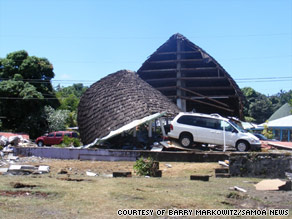
Quake, tsunami near American Samoa kills at least 22

The tsunami wave hit right in the middle of the harbor of Pogo Pogo, the capital.

The tsunami wave hit right in the middle of the harbor of Pogo Pogo, the capital.

American Samoa Gov. Togiola Tulafono, speaking from Hawaii, said Tuesday's quake ranked "right up there with some of the worst" disasters on the island. He said about 50 people had been treated for injuries so far but he expected that number to rise.

The quake hit the small cluster of South Pacific islands early Tuesday morning. By evening, Laumoli, standing outside the LBJ Tropical Medican Center morgue in the capital of Pago Pago, confirmed 22 deaths.

"I thought it was the end of the world," said Dr. Salamo Laumoli, director of health services. "I have never felt an earthquake like that before."

Laumoli feared more fatalities would turn up as rescue workers were still trying to access parts of the island severed by damaged infrastructure.

Laumoli said people in outlying villages on one end of the main island have been cut off because the main bridge was washed away.

"Two or three villages have been badly damaged," he told CNN International. Video Listen to Laumoli speak about the impact of the quake and tsunami »

Tulafono cited extensive damage to roads, buildings and homes, and said he had spoken to the military about mobilizing reserve forces for assistance.

The Pacific Tsunami Warning Center in Ewa Beach, Hawaii, canceled tsunami watches and warnings for American Samoa about four hours after the earthquake hit. However, a tsunami advisory is still in effect for for the coastal areas of California and Oregon.

The Japan Meteorological Agency also activated a tsunami advisory along its eastern coast. The precautionary alert means that the height of a possible tsunami wave would be less than a foot and a half.

President Barack Obama "declared a major disaster exists in the Territory of American Samoa" late Tuesday and ordered federal aid to supplement local efforts. The declaration makes federal funding available to affected individuals.

The tsunami waves hit right in the middle of the Pago Pago harbor, the capital, said Cinta Brown, an American Samoa homeland security official working at the island's emergency operations center. The water devastated the village of Leone.

"The wave came onshore and washed out people's homes," Brown said.

The same happened on the hard-hit east and west sides of American Samoa, she said.

The quake generated three separate tsunami waves, the largest measuring 5.1 feet from sea level height, said Vindell Hsu, a geophysicist with the Pacific Tsunami Warning Center. Preliminary data had originally reported a larger tsunami.

Officials in the U.S. territory issued a clear call and were focusing on assessing the damage, Brown said.

Reports of damage were still emerging, but a bulletin from the Pacific Tsunami Warning Center said the waves "may have been destructive along coasts near the earthquake epicenter and could also be a threat to more distant coasts. Authorities should take appropriate action in response to this possibility."

Tulafono, the governor, was on his way back home Tuesday night on one of two U.S. Coast Guard C-130 transport planes flying to American Samoa with aid.

The Coast Guard also will transport more than 20 officials from the Federal Emergency Management Agency to American Samoa, said John Hamill, external affairs officer for FEMA in Oakland, California.

The FEMA team will include a variety of debris experts, housing experts, members of the Corps of Engineers, and other disaster relief specialists, Hamill said.

Tulafono told reporters Tuesday that it was hard being away from home when disaster came calling. It was a time, he said, for families to be together.

Those who experienced the massive quake described it as a terrifying event.

Brown was standing in a parking lot when her sports utility vehicle began rocking left and right. Link...

More stories coming soon...


D I S C L A I M E R :

Clarification: All of the contents provided on worldnewskhi.blogspot.com are hyperlinks. NO story are created or produced by us. Our job here is to provide simple hyperlinks and easy guidance for users to find stories on single page. We DO NOT create News here! If you find any content that is violating the copyright law, please send an email to naveed4pkk@gmail.com