Swine flu case rise to three in Pakistan: official

The first swine flu case in Pakistan was detected on August 10

ISLAMABAD — Health officials in Pakistan confirmed Friday that they had detected another two cases of swine flu in the country.

The first swine flu case in Pakistan was detected on August 10 and a cabinet minister told the national assembly that precautionary measures had been taken.

"Swine flu was detected in two patients after they were admitted (to the) Pakistan institute of medical sciences," Doctor Waseem Khawaja, a spokesman for the hospital told AFP.

"We sent their blood samples to the national institute of health and they confirmed that both the patients are suffering from swine flu," he said.

Around two million Pakistanis live in Europe, North America and other countries where the swine flu pandemic has appeared.

Both new Pakistani patients travelled from Arab countries and had been kept in an isolation ward with fever, flu and coughs, doctors said. Link...

UN security council passes resolution on nuclear disarmament

Obama hails resolution as a milestone along the way to 'a world without nuclear weapons'

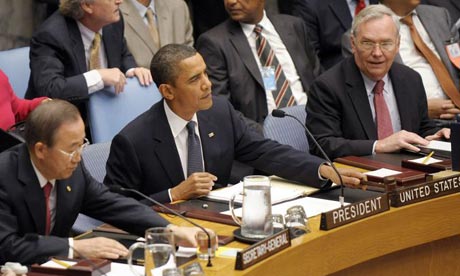
Barack Obama presides over a UN security council meeting on nuclear weapons.

Barack Obama presides over a UN security council meeting on nuclear weapons. Photograph: Emmanuel Dunand/AFP

Barack Obama today hailed a UN security council resolution on disarmament and non-proliferation as a milestone along the way to "a world without nuclear weapons".

Obama, the first US president to preside over a security council session, said the next twelve months would be "absolutely critical" in ensuring whether the resolution would succeed in reversing the spread of nuclear weapons and setting the world along the path of multilateral disarmament.

He said he had no illusions about the difficulties ahead, but he added "there will also be days like today" when the world came together for the common goal of disarmament and countering proliferation.

Today's resolution calls for the nuclear weapons states to ratify a ban on nuclear testing - something the US senate has yet to do - and negotiate a new treaty to stop the production of fissile material. It also calls for on them to join the disarmament process being led by the US and Russia, who account for more than 90% of the world's nuclear weapons between them.

The document also endorses a string of measures intended to strengthen the Non-Proliferation Treaty (NPT), ahead of a major review conference next May.

Those measures focus on attempts to raising the costs of exiting the treaty, so that states cannot import nuclear technology as NPT signatories, build up a civil nuclear programme legally, and then walk out of the treaty and divert their programme to building weapons, all without breaking international law.

The resolution urges exporting countries to make sales of nuclear technology conditional on the customer nation agreeing to intrusive UN inspections, and requiring the return of the technology in the event of withdrawal from the NPT.

The relevant clauses are all non-binding representing the difficulty of finding consensus among the council members. France, in particular, had objected to strong language calling directly for the abolition of nuclear weapons. Mexico wanted more of the resolution to require action from the weapons states with less onus on the non-weapons states.

However, it will be presented by Obama as the first significant step towards the repair of the NPT, and to the distant goal of a world free of nuclear weapons. Link...

Feds file bomb plot charge against terror suspect

NEW YORK — Terrorism suspect Najibullah Zazi plotted for more than a year to detonate homemade bombs in the United States, had recently bought bomb-making supplies from beauty supply stores and was looking for "urgent" help in the past two weeks to make explosives, an indictment charged Thursday.

Zazi, arrested in Denver last weekend on a count of lying to terrorism investigators, was charged in New York with conspiracy to use weapons of mass destruction. He appeared in a Denver courtroom Thursday on the lesser charge.

The two-page indictment offers few details, but a separate document — a government motion seeking to deny bail to the 24-year-old Afghan immigrant — lays out evidence gathered by investigators.

The airport shuttle driver began plotting to "use one or more weapons of mass destruction" between Aug. 1, 2008, and September 2009 against the United States, the papers say. The papers offer few specifics on where and when an attack might have been planned, but counterterrorism agents fear he and others might have been planning to detonate homemade bombs on New York City commuter trains.

The document says that on Sept. 6 and 7, Zazi tried to communicate with another individual "seeking to correct mixtures of ingredients to make explosives."

"Each communication," the papers say, was "more urgent than the last."

On those days, Zazi rented a suite at a hotel in his hometown of Aurora, Colo., authorities charge. The room had a kitchen, and subsequent FBI testing for explosives and residue in the suite found the presence of residue in the vent above the stove.

In July and August, Zazi bought unusually large amounts of hydrogen peroxide and acetone products from beauty supply stores in the Denver metropolitan area, the document says. He searched the Internet for home improvement stores in Queens before driving a rental car for a two-day trip to the city, the document says.

Zazi has publicly denied any terrorist plotting — and the documents don't specify a specific time and place of a possible attack. The arrests were followed by a flurry of nationwide warnings of possible strikes on transit, sports and entertainment complexes.

But a series of searches in Denver and New York City over the past two weeks — including high-profile raids on Queens apartments that netted backpacks, cell phones and a scale — haven't found any evidence of explosives.

John Choy, a salesman for 707 Beauty Supply and Fashion Plus in the Denver suburb of Aurora, said FBI agents came to his store about two weeks ago and asked him whether he sold hydrogen peroxide to anyone recently. Choy said that the store sells only a few small bottles a year and that no one who bought it fit the description of Zazi.

Authorities planned to transfer him to the federal court in the New York borough of Brooklyn to face the new charge.

Zazi; his father, Mohammed; and a New York City imam were appearing Thursday in Denver and Brooklyn courts on counts of lying to terrorism investigators. The imam, Ahmad Wais Afzali, was released on $1.5 million bond after a hearing Thursday.

A second, unrelated indictment unsealed Thursday in the same court charged a Brooklyn man with supporting terrorism in what authorities say is an investigation. An indictment alleges Betim Kaziu traveled to Pakistan this year to try to receive training from a militant group linked to al-Qaida, and tried to go to Afghanistan and Iraq to fight against U.S. forces there.

Kaziu was to be arraigned later Thursday. Prosecutors did not have the name of his attorney. Link...

'Good' war turns sour for Obama

Six months after proclaiming a new commitment to the war in Afghanistan, United States President Barack Obama is under growing pressure to make what would amount to a U-turn in US policy and scale back America's commitment to a conflict that many experts - and a majority of the public - fear may be unwinnable.

The debate was thrown into stark relief by the leaked report of General Stanley McChrystal, the commander of US and allied forces in Afghanistan, warning that the war might be lost within a year without a further boost in troop strength and a major change in strategy to combat the spreading Taleban insurgency.

McChrystal's bleak assessment coupled with Washington's frustration with the Afghan leader Hamid Karzai and the fraud-ridden election over which he presided, has reignited a rift between Vice-President Joseph Biden and Hillary Clinton, the Secretary of State, over how the war should be waged.

It has also left Obama facing a fateful choice: whether to go along with his generals and send yet more troops, or stand current policy on its head.

Spoken or unspoken, behind the debate lurks the Vietnam War and the current conflict's growing similarities with it. The stakes are now huge - so huge that the President barely mentioned Afghanistan in his address to the United Nations General Assembly yesterday. If Washington is perceived as opposing a further troop build-up, or leaning towards a reduction, then other countries in the coalition, where the eight-year-long war is even more unpopular than in the US, will rush for the exits.

Hitherto, the issue of the war in Afghanistan has seemed straightforward. In contrast to Iraq, Afghanistan has been the "good war" - a war of necessity, fought to make sure that a repeat of the 9/11 attacks, directed from Afghanistan by an al Qaeda sheltered by the Taleban, would never occur again.

Underlining this reinvigorated commitment, Obama authorised an increase in US strength in Afghanistan to 68,000 by the end of the year, and named McChrystal, previously in charge of US special forces, as his new commander on the ground. But the latter's recommendation of a boost of 30,000 to 40,000 confronts this president with a dilemma akin to that facing his predecessor over Iraq three years ago: to surge or not to surge? Essentially the choice, in strategic jargon, is between counter-terrorism and counter-insurgency.

The latter, implying a broad war against the Taleban to prevent it returning to power, seems to be what McChrystal has in mind, and has long been backed by Clinton. Only this week, she had scathing words for those who argued that al Qaeda was no longer a factor in Afghanistan. "If Afghanistan is taken over again by the Taleban, I can't tell you how fast al Qaeda would be back."

The Vice-President wants a narrower focus on al Qaeda itself, in Afghanistan and Pakistan, where security forces have scored some important successes against the terrorist organisation and its Taleban allies. Under this approach, the US would require fewer forces.

Instead of trying to protect the general population from the Taleban and operating a "hearts and minds" policy to win over civilian support, it would concentrate on targeted strikes on al Qaeda operatives, relying on umnanned drones, missile attacks and the special forces where McChrystal is an expert. The training of Afghan government forces would be speeded up.

A third faction advocates a compromise - scaling back the requested troop increase, or starting to reverse it, while at the same time ensuring that the country does not collapse into chaos.

The White House and Pentagon are studying the report, and it will be "weeks" before a decision is made, Administration officials say. But Obama, once so trenchant, is hedging his bets. All options are on the table, he indicated during his blitz of the talk shows this week. "The first question is, are we doing the right thing?" he told CNN.Complicating matters further, Congressional leaders are demanding a personal accounting from McChrystal on how the war is going. In the meantime, Obama is increasingly in a corner.

As Republicans constantly remind him, for the US to wind down its commitment would send a message of weakness and inconsistency to friends and foes alike. But to press on with a long, inconclusive war in a distant corner of Asia carries well-known and equal perils.

Events are bearing out the famous aphorism of Mark Twain, that "while history doesn't repeat itself, it rhymes".

TWO ASIAN WARS

Similarities: As in the former South Vietnam, Washington is propping up a corrupt regime in Afghanistan that does not command the allegiance of many of its people. In both, the US is trying a "hearts and minds" campaign to win the loyalty of civilians - and failing. In Afghanistan, as in Vietnam, the goal of the conflict is not clear.

AFGHANISTAN
Length: 8 years, 2001 to 2009
US troops: 60,000
Cost: US$185 billion
Deaths: 842
Justification: Afghanistan is a post-Cold War conflict, in response to the terrorist attacks of September 11, 2001.

VIETNAM
Length: 8 years, 1965 to 1973
US troops: 500,000 at its height
Cost: US$600 billion in today's dollars
Deaths: 58,000
Justification: Vietnam was fought in the name of the "domino theory" - that if one country in Southeast Asia went communist, the rest would follow.

Link...

Taliban target tribal elders

Pakistani paramilitary soldiers stand behind recovered ammunition and blindfolded suspected militants who were captured during search operations in the area, as they are presented before the media in Tamirgrah, the main town of Pakistan's Lower Dir district, Wednesday, Sept. 23, 2009. (AP Photo/Ruhullah Shakir)

PESHAWAR: To counter Taliban insurgency in the northwestern tribal and adjoining areas, Pakistani authorities have raised local militias, known as "Qaumi Lashkars" comprising of people of different age groups. So far, none of the group of volunteers of any "Qaumi Lashkar" was heard to have achieved any worthwhile success against the Taliban militants. Contrarily, the leaders and volunteers of these militias are becoming easy targets of Taliban militants who are far superior in the art of guerrilla warfare than the untrained and undisciplined militias.

Taliban insurgents on Thursday shot dead seven leaders of the pro-government tribal lashkar in the northwestern Bannu district in an ambush. The victims included the tribal chief Malik Sultan, who was active in raising a government-sponsored militia against militants in the area, said Iqbal Marwat, a local police official.

"All tribal elders were on the way to attend a meeting with security officials in Bannnu", he said Bannu borders the rugged tribal region of North Waziristan where Washington says al-Qaida and Taliban established bases after the 2001 US-led invasion ousted the Taliban regime in neighbouring Afghanistan.

The ambush was followed by another militant attack on volunteers of peace committee in Swat when Taliban killed two members of the anti-Taliban committee. The assailants struck when members of the "peace committee" were sleeping in the Swat’s Sertelegram area, officials said.

Last month, Taliban killed nine members of a tribal volunteer force in Mohmand Agency while captured three tribesmen.

Earlier nine people, including Malik Rehmatullah, head of the Qaumi Lashkar, were killed and four others injured in a suicide attack on a mosque in Mamond area of the troubled Bajaur Agency. Rehmatullah was appointed as chief of the lashkar after militants had killed the lashkar’s chief Malik Fazal Mabood along with two tribesmen.

According to a report prepared by the "Pakhtun Amn Lashkar" (Pashtun peace force), more than 400 Lashkar members battling the Taliban in tribal areas, Swat, Dir and Buner regions have been killed during the past three months. Taliban squads are now targeting these Lashkars more fiercely than they used to attack army troops and police officials, the report said.

"If the trend of Lashkar leaders' murder continues, it might discourage the public and the police and armed forces' personnel," said Syed Kamal Shah, a convener of the Pakhtun Amn Lashkar. Link...

Iranian filmmakers hit out at Ahmadinejad

SAN SEBASTIAN, Spain — Several Iranian filmmakers Thursday used the San Sebastian film festival to condemn the Tehran regime and President Mahmoud Ahmadinejad's speech at the UN General Assembly.

Protesters, including members of the festival jury, gathered inside the festival building behind a huge banner that read: "We do not want a nuclear bomb, we want peace and democracy" in Iran.

All wore green scarves, the colour of the opposition candidate in the June 12 elections, Mir Hossein Moussavi.

"Freedom in Iran! Peace in the world!" shouted Hana Makhamalbaf, an Iranian filmmaker and an organiser of the protest, prior to the showing of her film "Green Days."

Makhamalbaf, 21, is the daughter of director Mohsen Makhmalbaf, who is close to Moussavi.

Her sister Samira, 29, who is a member of the festival jury this year, also took part in the protest, as did Mohammad Rasoulof, whose film "The White Meadows," a veiled attack on the Tehran regime, was shown on Saturday.

Another Iranian filmmaker, Shahram Karimi, said he was "shocked" by Ahmadinejad's controversial speech to the UN General Assembly on Wednesday,

"This government is dangerous. For me, Ahmadinejad is not the Iranian president," he said.

In the UN speech, which triggered a walkout by a dozen delegations, the Iranian president accused Israel of "inhumane policies in Palestine" and of seeking to "establish a new form of slavery, and harm the reputation of other nations, even European nations and the US, to attain its racist ambitions."

"It's terrible, I can't believe it," another Iranian filmmaker, Bahman Ghobadi, said of the speech. "The government and the people are two separate things in Iran, we need a big change."

Iran was rocked by mass protests against Ahmadinejad's disputed re-election victory in June, and in the initial crackdown some 4,000 people, including top reformists, political activists, and journalists were arrested.

About 140 of them have been put on mass trials before a Tehran revolutionary court, which the opposition denounces as a "show trials."

"I'm very proud of what they did," Karimi said of the protesters.

The 57th edition of the San Sebastian film festival, the oldest and most prestigious event of its kind in the Spanish-speaking world, concludes on Saturday in the coastal city in northern Spain.

A total of 15 films are competing for top Golden Shell award this year. Link...

China hedges emissions pledge

By Antoaneta Bezlova

BEIJING - China, although pledging to break away from its highly polluting economic path, has managed to avoid compromise on what it believes is its national agenda.

Speaking on Tuesday at the United Nations summit on climate change, Chinese President Hu Jintao promised that his country - the world's largest greenhouse gases emitter - will cut its emissions "notably" by 2020, and he drew applause for setting new standards as a developing powerhouse committed to curbing its pollution. But he did not pledge to make these carbon emissions cuts mandatory.

What is more, he tied the planned changes to a "notable" decrease in carbon intensity - or the amount of emissions per unit of economic output by 2020 - of China's economy, meaning the overall level of emissions could still grow even if the amount per unit was less.

Ahead of the UN summit, Chinese experts had predicted Beijing would use a new tack compared with its uncompromising stance in the past, which rejected any commitments on cutting emissions.

China agrees that action on climate change is needed but insists that accumulated emissions in the atmosphere are the historical responsibility of developed nations, who should be the ones to shoulder the bigger part of the work by pledging investment to poorer countries and committing to mandatory cuts. So far, Beijing has refused to agree to cap its own fast-growing emissions.

The possibility of a new conciliatory approach from Beijing was outlined by Sha Zukang, a senior Chinese diplomat and the UN undersecretary general for economic and social affairs last week.

"China is likely to take a step back at this summit in order to advance later," he said in an interview with China Business News.
The UN summit is regarded as preparatory for the crucial meeting in Copenhagen in December, when world leaders are expected to forge a new agreement to replace the Kyoto protocol to combat climate change.

As the clock for agreeing a deal that works for everyone is ticking, developing powerhouses like China and India have come under increasing pressure to commit to changes in the way they navigate their economies.

China is the largest emitter, followed by the United States. Together they account for about 40% of the world's total emissions, split almost evenly between them.

"The pressure on China to take action has become even more intense since the election of Japan's new Prime Minister Yukio Hatoyama," Gao Heng, senior researcher at the Institute of World Economics and Politics of the Chinese Academy of Social Sciences, told Inter Press Service. "Tokyo has pledged action, and Beijing can't be seen sitting idle."

Japan, which generates more than 4% of the world's greenhouse gases, has promised a 25% cut in greenhouse gas emissions from 1990 levels by 2020. Hatoyama said his country was also ready to contribute money and technical help to poorer countries to cut emissions.

The need for political momentum was yet again articulated by UN secretary general Ban Ki-moon at the summit. He remarked that talks were progressing at "glacial" speed.

"Instead of demanding concessions from others, let us ask how we can contribute to the greater good," he said, addressing the leaders gathered in the General Assembly hall. "The world's glaciers are now melting faster than human progress to protect them and us."

In the same interview, Sha pointed out that in view of the current deadlock in negotiations, it was important for China to aid the formation of a "general consensus" about reducing emissions. "The concrete steps and areas of reduction could be decided later," he told the business paper on September 16.

Proposing to use the carbon intensity standard as a benchmark for how carbon emissions reductions are measured dovetails with China's national agenda of putting development first. Instead of aiming for an overall cut in its emissions, Beijing is eyeing increasing the efficiency of its economy, which is already a part of its current five-year economic plan.

Hu's speech was primed to be a breakthrough in China's position on climate change, promising to underscore the country's ascending diplomatic role in global affairs. Media experts like Ma Xiaolin, editor-in-chief of ChinaBBS.com, the country's largest grassroots information portal, predicted the speech would transmit "China's voice" to the world.

But the promises outlined in the speech, while new, are sketched with keeping China's national interests at heart. Beijing did not commit to any specific numerical targets, which means there is room for future maneuvering in setting them.

"We should make our endeavor on climate change a win-win for both developed and developing countries and a win-win for both the interests of individual countries and the common interests of humanity," Hu emphasized before world leaders.

Reducing China's reliance on coal, 70% of its total energy mix, will be a lengthy process, predicted Gao. "The government knows it has got to get its action together, but the problem is that there are very few immediate alternatives," he said.

Hu said his country would take four steps toward greener development. Apart from cutting carbon dioxide emissions by a "notable margin" by 2020 compared with 2005 levels, he pledged to drastically increase the size of forests, increase the use of nuclear or non-fossil fuels to 15% of power by 2020, and work to develop a green economy. Link...

Musharraf: Additional Troops Needed in Afghanistan

Former Pakistani president Gen. Pervez Musharraf said that President Obama should have complied "yesterday" with Gen. Stanley A. McChyrstal's recommendation to send more U.S. troops to Afghanistan.

"I think you should take it immediately. You should have taken it yesterday," Musharraf told ABC News in an exclusive interview.

Musharraf made his comments following the leak of McChrystal's security assessment that called for additional U.S. troops to fight in Afghanistan. In the assessment, McChrystal said more troops alone cannot achieve success "but will enable implementation of the new strategy. Conversely, inadequate resources will likely result in failure." Link...

Hafiz Saeed's arrest will take time: Pakistan

New York: Pakistan, in a startling volte face, admitted on Thursday that Hafiz Saeed, the alleged mastermind of the 26/11 Mumbai terror attacks had not been arrested as had previously been thought, saying this would "take time".

At the same time, Pakistani Interior Minister Rehman Malik said that the prosecution of Saeed, the founder of terror group Lashkar-e-Taiba (LeT), should not be made a precondition for resuming the sub-continental dialogue process that India froze in the wake of the November 26-29, 2008 Mumbai carnage that claimed the lives of over 170 people, including 26 foreigners.

"When the leads culminate in some evidence that he is a criminal, I will not waste a moment. He will be arrested. But it will take time," Malik told NDTV news channel in an interview.
"We have to follow our law. As we are respecting the investigation and the courts of India, I request you to request our courts. Wait for some time. The court process has started. We mean business. Whatever we have committed on all forums, we mean business," Malik added.

Pakistani Prime Minister Yousaf Raza Gilani had confirmed Tuesday that Saeed had been arrested the previous day after two first information reports (FIRs) were registered against him under the anti-terrorism act.

On Thursday, Saeed's lawyer had denied the arrest, saying an appeal had been filed against the FIRs in the Lahore High Court.

Reiterating that India had not presented adequate evidence against Saeed, Rehman maintained that his prosecution should not be made a precondition for resuming the India-Pakistan dialogue process.

"As far as Hafiz Saeed is concerned, please do not make this a precondition. Because you know yourself that what you have given us is not evidence," Malik contended.

When it was pointed out that India had submitted evidence of Saeed's role in the Mumbai mayhem, Rehman replied: "Look, there is a difference between leads and evidence. If we can arrest (Lashkar-e-Taiba commander Zakiur Rehman) Lakhvi, why would we not arrest Saeed?

"The only request that I am making to India is give us credible evidence. I am not rejecting those leads. Only three weeks have passed. Give me some time to investigate. You have seen two FIRs in Faisalabad. It is not window dressing. Believe me," the interior minister added.

When it was pointed out that the FIRs were not in connection with the Mumbai attacks, Malik said: "He was instigating people. So the FIR was registered."

Turning to the peace process, Malik said: "I think Pakistan's offer of composite dialogue must be accepted. There is no harm in sitting together. Even enemies sit together. We do not treat you as enemies. Let us be friends."

Noting that he hoped to meet his Indian counterpart P Chidambaram, Malik said: "I expect to meet my counterpart. I have no hang-ups with that."

"My appeal to India would be that move away from the past. We need to have a fresh start. Let's first identify our issues. You identify your issues as we have done. We are ready to take this forward," he added. Link...

Fed scales back 2 emergency lending programs

WASHINGTON — The Federal Reserve on Thursday said it is further scaling back two emergency lending programs as the economy improves.

The Fed will reduce the amount of money available to banks in short-term loans under a program called the Term Auction Facility, or TAF.

For 84-day loans, the Fed will provide a total of $50 billion in loans in October, and $25 billion each in November and December. By early next year, these loans will be shortened to 28 days.

For 28-day loans that also are currently offered, the Fed will continue to make $75 billion available monthly through January.

The Fed also said it will assess whether the TAF should be made a permanent fixture and is seeking public comment on that notion. The program was set up to give banks a ready source of short-term cash beyond the Fed's emergency lending facility — known as the discount window_ where firms can draw low-cost overnight loans.

Across the Atlantic, the European Central Bank said that given limited demand and improved financial conditions, it will stop offering 84-day loans following an operation on Oct. 6.

The Fed also is cutting back on a program where investment firms can temporarily swap risky securities for super-safe Treasury securities.

The Fed says $50 billion worth of Treasury securities will be made available for October, down from the current $75 billion. Operations in November and December will be trimmed to $25 billion each.

The actions respond to "continued improvements in financial market conditions," the Fed said. It builds on earlier steps, announced in late June, to pare down the two programs.

With the economy moving from recession into recovery, the Fed is pulling back on some of the extraordinary support it has provided to banks and other companies to cope with the worst financial crisis since the 1930s.

Fed Chairman Ben Bernanke and his colleagues on Wednesday said they will slow the pace of $1.45 trillion program intended to force down mortgage rates and shore up the housing market. And in August, the Fed signaled that it would wind down a $300 billion government debt-buying program aimed at lowering rates on all kinds of consumer debt.

The Fed's support has caused its balance sheet to jump to just over $2 trillion, more than double the level before the crisis struck.

Weaning companies and the economy off the support will be a high-wire act for the central bank. Fed policymakers need to leave the special programs intact long enough to support the recovery — but not so long as to fuel inflation later. Link...

Leaders gathering for G20 summit


Oxfam protesters in Pittsburgh
Protesters have been assembling in Pittsbur

World leaders are meeting in the US city of Pittsburgh later as the two-day G20 summit gets under way.

Economic stability, financial regulation, climate change and bankers' bonuses are set to top the agenda.

With many major economies are beginning to climb out of recession - attention will turn to when and how to withdraw government stimulus packages.

Thousands of extra police will be on duty, as officials prepare for demonstrations by activists.

The previous G20 meeting, in London in April, was marred by clashes between police and protesters.

The leaders are gathering after the UN general assembly in New York, and are due to meet for a working dinner on Thursday evening.

IMF debate

President Barack Obama has led a campaign to smooth out imbalances in the flow of global capital to try to secure greater long-term economic stability.

The US proposal calls on economies such as China, Brazil and India to boost domestic consumption in order to lower their trade surpluses.

Meanwhile the US and Europe would encourage more saving to reduce long-term budget deficits.

Other discussions will involve the continuation of talks over whether countries such as China, India and Brazil should have greater say on the board of the International Monetary Fund (IMF).

'Party over'

Cracking down on bankers' bonuses has popular appeal with the public, and so it is expected that an agreement will be reached on how that might be achieved.

There will also be talks on "regulatory harmonisation" - making sure that countries do not try to attract investment by offering looser rules.

Earlier, Chancellor of the Exchequer Alistair Darling warned bankers that the "party was over" and they must realise that the world has changed.

He wants a limit on bonuses and rules to allow banks to be able to get them back if bankers make losses later.

And he said there was a limit to how much could be achieved by regulation and that bankers must realise that they have to change their behaviour.

Mr Darling wants to use regulations to force banks to limit the proportion of their profits that they can give out in bonuses and make sure there are no rewards for failure. Link...

NYMEX-Crude drops as supply rise, home sales weigh

 NEW YORK, Sept 24 (Reuters) - U.S. crude oil futures fell
sharply on Thursday, weighed down by rising U.S. inventories,
tepid demand and a slump in existing home sales.
 "(Oil) broke under $68 and triggered some sell stops," said
Tom Bentz, analyst at BNP Paribas Commodity Futures Inc in New
York.
 Wall Street equities turned negative on Thursday when the
National Association of Realtors said sales of previously owned
U.S. homes unexpectedly fell in August. [ID:nN24343088] [.N]
 Wednesday's U.S. Energy Information Administration's
inventory report showed crude stocks rose 2.8 million barrels
in the week to Sept. 18, against a forecast draw down. [EIA/S]
 Distillate stocks rose 3.0 million barrels to 170.8 million
barrels, more than forecast and the highest level since the
week to Jan. 14, 1983, the EIA said.
 Gasoline supplies also soared, jumping 5.4 million barrels,
much more than forecast.
 The EIA said on Thursday that natural gas storage rose 67
billion cubic feet last week, just below the forecast for a 68
bcf build in a Reuters poll of analysts. [ID:nEIA000826]
 PRICES
 * On the New York Mercantile Exchange at 10:40 a.m EDT
(1440 GMT), front-month November crude CLX9 was down $2.76,
or 4 percent, at $66.21 a barrel. Ranged from $68.77 to a
intraday low of $65.79, the weakest since $65.23 on Aug. 17.
 * In London, November Brent crude LCOX9 fell $2.79, or
4.1 percent, to $65.20 a barrel, trading from $64.97 to
$67.98.
 * NYMEX October RBOB RBV9 fell 7.59 cents, or 4.45
percent, to $1.6290 a gallon, trading from $1.62, lowest since
$1.6010 on July 13, to an intraday high of $1.70.
 * NYMEX October heating oil HOV9 fell 6.84 cents, or 3.89
percent, to $1.6910 a gallon, trading from $1.6866, lowest
since $1.6601 on July 30, to an intraday high of $1.7574.
 * The November/November RBOB crack spread <0#rb-cl=r> was
at $2.93, after ending at $3.32 on Wednesday. The
November/November heating oil crack spread <0#cl-ho=r> was at
$6.17, after ending at $6.23 on Wednesday.
 * The spread between the current front month and the
five-year forward crude contract CLc61 was at $16.55, based
on the November 2014 contract Wednesday settlement at $82.76.
The spread ended Wednesday at $13.79.
 MARKET NEWS
 * The number of U.S. workers filing new claims for jobless
benefits unexpectedly fell last week. Continued claims also
fell more than expected. [ID:nN23268507]
 * World equities slipped from the previous day's 11-month
high on Thursday as caution ahead of the Group of 20 summit
prompted investors to cut back on risky assets. [MKTS/GLOB]
 * Japan's crude imports fell more than 10 percent in August
from a year ago, the lowest for August since 1989.
[ID:nT19559]
 * U.S. copper futures tumbled to a five-week low after the
existing home sales data. [ID:nN24373768]
 * Nigeria's foreign minister said a government amnesty in
the Niger Delta was working, noting oil output was set to rise
as a cease-fire holds. [ID:nN23424136]
 * Nigeria has raised its official selling price for October
Bonny Light BFO-BON crude oil to dated Brent plus $1.65 a
barrel, up from dated plus $1.35 in September, a Nigerian
National Petroleum Corporation document said. [ID:nLO285616]
 * About 250,000 barrels per day of refined fuel are
smuggled out of Iran, a senior official said. [ID:nDAH434022]
 * An exiled Iranian opposition group said it had identified
two previously unknown sites where it said Iran is working on
developing nuclear weapons detonators. [ID:nLO255601]
(Reporting by Robert Gibbons; Editing by Lisa Shumaker)
Link...


There's Water on the Moon, Probes Confirm

The long-standing theory of the moon being bone dry is now all wet. That's because large swaths of the lunar surface are saturated with water—or at least the ingredients needed to make water, a suite of new studies confirm.

A trio of satellites—including India's recently failed lunar probe, Chandrayaan-1—picked up the light signature of water (H2O) or hydroxyl (OH) or both while mapping the moon.

The other two probes that found moon water are NASA's Cassini and Deep Impact spacecraft.

But don't go planning a lunar pool party just yet: The water or hydroxyl molecules on the moon are bound to other molecules and exist in trace amounts over the entire lunar surface.

Still, scientists estimate there is about a quart of water and/or hydroxyl for every cubic yard of lunar soil. (Get the facts on moon exploration.)

The surprise finding suggests moon water may be a renewable resource, created constantly as a result of interactions between charged particles from the sun and the lunar surface. (Take a moon quiz.)

"The Heck With Hydrogen"

The news comes close on the heels of NASA's announcement that its Lunar Reconnaissance Orbiter recently detected large amounts of hydrogen, a possible marker for water, at the moon's south pole.

Larry Taylor, a planetary geologist at the University of Tennessee, said his team's findings go one step further.

"All [the LRO scientists] can say is they've found hydrogen," said Taylor, a co-author on one of the new studies, which is based on data from Chandrayaan-1. "We're saying, The heck with the hydrogen! It might actually be water."

Taylor and his team think the lunar water and/or hydroxyl are created when hydrogen in the form of protons from the sun's solar wind strike oxygen-rich minerals and glasses on the moon's surface.

"You have protons and you have an oxygen looking for somebody, and they make a marriage," Taylor said.

Moon Water a Mind Changer

It's unclear at present whether the satellites detected water or hydroxyl on the moon, but both substances could prove useful to future lunar missions.

Even if the lunar soil contains only hydroxyl, Taylor said, that hydroxyl can be extracted and combined with lunar hydrogen to form freshwater.

A ready supply of water on the moon would in turn reduce the payloads that would need to be taken into space to maintain a future lunar outpost.

LCROSS, a probe that will soon smash into a permanently shadowed crater on the moon, might help answer some of the lingering questions.

The controlled impact will send up a plume of material into the light, so scientists can get a better look at what's inside.

Overall, Taylor noted that he had previously been a staunch proponent of the dry-moon theory, but he is elated to be proven wrong.

"That's how science goes," he said. "It's about changing your mind about things." Link...

Microsoft Courier Notebook Could Raise the Bar for Tablets

It looks like Microsoft is taking an exuberant stab at stealing the Apple Tablet's thunder. Microsoft's Courier tablet ...err "notebook" computer is reportedly in the "late prototype" stage of development. It is a tablet style computer that features dual multi-touch 7 inch displays in a clamshell configuration. A video posted on YouTube by Gizmodo (see below) demonstrates a mock-up of its exceptionally advanced interface. While there's no promising that this device will ever actually make it to production, if it does, it will satisfy the demands of both the tablet and netbook markets.

Its design just makes sense, for a number of reasons.

Maximum screen real estate in a small package: Assuming each display has the 800x480 typical resolution of a 7-inch LCD, the Courier will have 125 percent of the number of pixels typical of a 10 inch netbook with a 1024x600 display. It will achieve this despite being approximately 30 percent smaller.

Intuitive input: One of the criticisms of conventional tablet design is that its input area eats into the display space. By having dual displays, you can have your working document on one screen and your virtual keyboard and virtual multi-touch track pad on the other.

Pen & Finger Multi-touch: Multi-touch is great for intuitive scrolling and object manipulation. Pen input is great for jotting notes and drawing. The Courier might be the first device to incorporate both.

As an e-book reader: Its folding design gives the Courier the intuitive look and feel of a standard paperback. Though its display won't be as easy on the eyes as the Kindle's gray scale ectrophoretic display, it returns readers back to a familiar form factor.

The Microsoft Courier still won't replace a full-sized laptop though. Even the best virtual keyboard is no match for the tactile response of the real thing. People who do lots of data-entry just won't be satisfied. Still, I think this is the perfect compromise for people who want higher performance than they're getting from a Smartphone, yet something more portable than a laptop.

I'd like to think someone at Microsoft has been reading my blog since the Courier seems to address every single issue I brought up regarding the rumored Apple Tablet, and it even uses my suggestion of using dual displays in a clamshell design. However, it's more likely that the design of the Courier is just intuitive in the natural progression of portable computers. Link...

South Africa too strong for Kiwis

By Jamie Lillywhite

AB de Villiers
It was the second fifty de Villiers has made against New Zealand

South Africa's Champions Trophy quest got back on track with a five-wicket victory over New Zealand in Centurion.

After losing their opening match to Sri Lanka they chose to field and bowled out the Kiwis for 214 in the 48th over.

Ross Taylor top-scored with six fours and two sixes in his 72, but fell to left-arm seamer Wayne Parnell, who claimed a one-day career-best 5-57.

AB de Villiers hit nine fours in an unbeaten 70 as South Africa reached their target with 53 balls remaining.

The New Zealand innings featured several partnerships that promised much but ultimately could not put sufficient runs on the board.

Brendon McCullum and Martin Guptill shared 46 in nine overs, ended when the latter picked out deep mid-wicket with his hook shot.

McCullum, who overcame a painful collision with Johan Botha when he slid into the crease and injured his neck, hit two sixes, top-edging over fine-leg and flat-batting over long-on.

He also hit some thumping drives down the ground but on 44 he mis-timed a sweep and the ball looped gently to backward square.

Grant Elliott shared 71 with Taylor before he was the first of two wickets for burly left-arm spinner Roelof van der Merwe, who extracted considerable turn at a sharp pace.

Wayne Parnell strikes
Parnell claimed the important wicket of Taylor in his maiden five-wicket haul

Taylor's controlled innings ended in the 47th over as the formidable pace duo of Parnell and Dale Steyn took the final five wickets inside three overs, leaving 13 deliveries unused.

After Graeme Smith departed in the sixth over of the South African reply, Jacques Kallis seemed keen to get on with the run chase.

He brought up the 50 with a deftly steered late cut off paceman Shane Bond, his fifth four, which took him to 26 from 16 balls.

He was on 29 when Bond was convinced he had edged behind to McCullum, who left everyone including the match officials in no doubt as to his feelings on Asad Rauf's rejection.

The same combination later did remove Kallis and wickets continued to fall, the fifth going down with 35 still needed from 85 balls, but Albie Morkel promptly punched his opening delivery off the back foot for four.

De Villiers ended the match in style with a typically fluent drive through the covers for four, as the South Africans restored their confidence ahead of their final group match against England on Sunday.

Skipper Smith was delighted with the performance and said: "It was great to see the guys improve a hell of a lot.

"The first 15 overs of the first game let us down but this time we bowled with good intensity and hit our areas hard."

Counterpart Daniel Vettori lamented his team's late collapse and said: "Our batters put us in a good position to launch in the final 10 overs for a score of around 250, but we never got that part of our game right. Credit though to South Africa for a good all-round performance." Link...

Flower expects England to bloom

Coach Andy Flower insists England are excited rather than weary as they prepare for their opening match in the Champions Trophy on Friday.

Despite arriving on the back of a gruelling summer schedule, which concluded with a 6-1 NatWest Series drubbing by Australia, and having just two days' practice to acclimatise to the high altitude in Johannesburg, England head into their opening Group B fixture against Sri Lanka thankful for a change of scene.

"We have had a long, hard summer back home, so getting out here and playing in this tournament, with the best players in the world, is very exciting for everyone," said Flower. "We are looking forward to that challenge."

He added: "There is no trouble at all getting the players up for this tournament. Being here and feeling the buzz about it, and looking forward to a couple of wins to get us through to the semi-finals is exciting for everyone."

While Australia's pacemen, led by a rejuvenated Brett Lee, cleaned up England's misfiring batsmen earlier this month, the threat now reverts to spin with Muttiah Muralitharan and Ajantha Mendis, whose remarkable rise continued with a starring display in the tournament-opening win over South Africa.

"It proved a tough series against Australia but the Sri Lankans will put forward a completely different challenge," said Flower. Link...

Former Pakistan Test player wants senior batsmen to quit

ISLAMABAD — Former Pakistan Test players are calling for the removal of senior batsmen from the limited-overs squad after Pakistan struggled to beat the West Indies by five wickets in the Champions Trophy group match.

"It's time the senior batsmen should say good bye," Ramiz Raja told a talk show on private television channel GEO Super after Wednesday's match.

The under-strength West Indies played valiantly after being bowled out for 133 but Pakistan reached the target in the 31st over despite losing five top batsmen.

Pakistan's experienced trio of Shoaib Malik, Mohammad Yousuf and Misbah-ul-Haq were out cheaply, leaving their team limping at 76-5 until young Umar Akaml (41 not out) and stand-in captain Shahid Afridi (17) guided the team to victory.

"They (experienced batsmen) looked novices while Akmal batted with much more maturity," Raja said.

Pakistan had kept faith with Yousuf, Malik and Misbah for the Champions Trophy despite the fact that they struggled against Sri Lanka in the limited-overs series last month.

"It looked as if they don't have bats in their hands," Raja said.

Former Test opener Aamir Sohail said that the experienced batsmen are not playing for the team.

"They are playing for their survival, they have always struggled on the wicket where there's seem movement," he said. Link...

'Pretty Woman' takes Hindu names for kids: report

NEW DELHI — The children of Hollywood star Julia Roberts have been given Hindu names during shooting for her latest blockbuster in India, which has upset some locals over its use of a temple, reports say.

The star of Pretty Woman arrived in India on September 18 to shoot for her upcoming movie, "Eat, Pray, Love", based on a best-selling book by Elizabeth Gilbert, and is filming 65 kilometres (40 miles) from the capital New Delhi.

The 42-year-old actress has run into controversy, however, with some devotees in the village of Pataudi reportedly upset by her presence after a vast security team of 350 guards sealed off their temple for filming.

"We are not allowed to enter the temple premises. They cannot stop us from worshipping because Julia Roberts is in there," one unnamed resident of Pataudi told The Indian Express newspaper.

The 42-year-old visited a local Hindu saint Swami Dharam Dev of the Hari Mandir Sanskrit Mahavidyalaya ashram on Wednesday who re-named her three children -- though only for their time in India.

"Julia came to seek blessings from me," Swami Dharam Dev was quoted as saying by The Times of India newspaper.

"I have named her twins Hazel and Phinnaeus as Laxmi and Ganesh while Henry will be called Krishn Balram," he said.

She is also learning how to make Indian bread and Dal, a typical dish made with pulses, for a scene in the movie in which she cooks at the ashram, which is a spiritual retreat. Link...

Cops crack down on movie piracy racket

Mumbai: The Mumbai Police Crime Branch on Tuesday claimed to have busted a major Bollywood movie piracy racket allegedly run by a Pakistan-based man. According to the police, the gang has illegally procured prints of at least 11 Bollywood movies, including Whats Your Raashee that is slated for release in theatres on Friday.

Two months ago, the police department had set up a team, which had officers of the police’s Social Service Branch also, to keep a tab on piracy cases and rackets.

“A few days ago, we received a tip-off that the print of Dil Bole Hadippa that was released on September 18 is already available in the market. However, despite making some efforts, we could not nab them,” said Joint Commissioner of Police (Crime) Rakesh Maria.

On Saturday, the team received a tip-off that a deal would take place for the print of yet-to-be- released Whats Your Raashee on September 20, near Guru Kripa Hotel at Kherwadi Junction. Link...

Travolta tells of trying to save son

LOS ANGELES: John Travolta has described how he fought to save his 16-year-old son's life by performing mouth-to-mouth resuscitation after the boy suffered a seizure at the family's holiday home in the Bahamas.

The film star, 55, was giving evidence at Nassau Supreme Court in the trial of two men accused of trying to extort $US25 million ($28.6 million) from him.

With his actress wife, Kelly Preston, 46, looking on, Travolta told how they were awakened by a nanny at 10.15am on January 2 after Jett collapsed in a bathroom.

''I ran downstairs with my wife to help my son,'' he said.

In the bathroom he found anassistant doing chest compressions on Jett. Travolta, who has not previously talked publicly about Jett's death, said he assisted with breathing help.

''[Jett] was autistic. He suffered from a seizure disorder,'' Travolta told the jury.

Tarino Lightbourne, an ambulance driver, and Pleasant Bridgewater, a lawyer and former Bahamas senator who allegedly acted as an intermediary, have pleaded not guilty to extortion.

Police say the alleged extortion involved a document related to Jett's treatment. It would have released emergency responders from liability if the family refused an ambulance, but police say that did not happen.

According to his family, Jett suffered from Kawasaki disease, which leads to inflammation of the arteries, and had a history of seizures.

Travolta arrived at court on Wednesday in an entourage of four-wheel-drives for his first appearance at the trial. Security was heavier than previous days, with police surrounding the courthouse. Link...

Daily Aspirin Cuts Colon Cancer Risk in People Genetically Prone to the Disease

Colon cancer is one of the most common cancers in the United States, diagnosed in more than 130,000 new patients each year. For most people, the life-time risk for developing colon cancer is about six percent, but the risk is more pronounced for those with hereditary colon cancer syndromes. Patients who have inherited one of these syndromes have an extremely high risk for developing colon cancer, approaching 90 to 100 percent. However, European researchers say people with the most common of these syndromes, Lynch syndrome, could significantly reduce their chances of developing colon cancer by taking daily doses of an inexpensive over-the-counter drug that’s been around for better than a century and continues to be at the forefront of emerging science—aspirin.

The researchers came to this conclusion after following 1,071 people with Lynch syndrome, which accounts for about five percent of all colon cancer. For about four years, half of the participants were given daily doses of 600 milligrams of aspirin, while the other half received a placebo. Tests done 29 months into the study showed no difference in colon cancer rates, but a follow-up after four years detected a significant difference. “To date, there have been only six colon cancers in the aspirin group as opposed to 16 who took placebo,” said John Burn of the Institute of Human Genetics at Newcastle University in Britain, who led the study. “There is also a reduction in endometrial cancer.”

A previous study by Harvard Medical School researchers found that regular use of aspirin may reduce the mortality risk of colon cancer by more than half by inhibiting the enzyme COX-2, which promotes inflammation and cell division and is found in high levels in tumors. The Harvard study showed that people who tested positive for COX-2 benefited more from aspirin use than those without the enzyme. But Burn has another explanation for aspirin’s protective effect. He theorizes that aspirin targets faulty stem cells, destroying them before they mutate into pre-cancerous cells. “If aspirin reduced the chances of such cells surviving, this would explain our results,” he said. Link...

Progress towards Alzheimer's vaccine: Israeli researcher

A woman (L) holds the hand of her husband, who suffers from Alzheimer's disease, on September 21, 2009 at a retirement home. An Israeli researcher working on a vaccine to combat Alzheimer's disease says he has made important progress following tests on gene-altered laboratory mice.
Photograph by: Sebastien Bozon, AFP/Getty Images

JERUSALEM - An Israeli researcher working on a vaccine to combat Alzheimer's disease said on Monday he had made important progress following tests on gene-altered laboratory mice.

"We have been able to stimulate an immune response and forecast the effects in inoculated mice carrying human genes," Alon Monsonego, who works with British and US researchers, told AFP.

"It is an important development" that could help find vaccines which could be used for individuals with a predisposition to Alzheimer's, the University of Beersheva researcher said.

Monsonego added that "inoculated mice were able to reduce plaques of beta-peptides, as well as inflammations and neuronal damage associated with the disease."

Monsonego's work which is aimed at finding a vaccine capable of reinforcing the immune system were published in the specialised Journal of Immunology.

A report on Monday by the Alzheimer's Disease International (ADI), which groups Alzheimer associations around the world, predicted that cases of the disease and other forms of dementia are expected to soar in the next few decades, due largely to a spike in cases in developing countries.

Just under 36 million people will be living with dementia in 2010, an increase of around 12 million on how many suffered some form of dementia in 2005, the report said. Link...

Thailand's long battle with HIV/Aids

It is no surprise that Thailand has held the largest ever trial of an HIV vaccine. The South East Asian country has long been at the forefront of the battle against HIV and Aids.

Aids awareness campaign in Bangkok in 2000
Thailand has worked hard to fight HIV/Aids but it is still a key problem

"I did this for others," said 33-year-old electrician Thanad Yomha. "It's for the next generation".

Thanad was one of more than 16,000 Thais from the provinces of Chonburi and Rayong who volunteered to take part in the trial, which was run jointly by the Thai government and US military.

The researchers had sought HIV-negative men and women between the ages of 18 and 30 years old who were at an average risk of infection.

They wanted to test a combination of two vaccines, ALVAC and AIDSVAX, which on their own had previously not worked.

From 2003 to 2006, half of the volunteers received the vaccine, and the other half a placebo. Those taking part never learnt which one they had been given.

After that, the volunteers received an HIV test every six months for the next three years.

Of those who took the dummy injection, 74 of 8,198 volunteers became infected, compared with 51 of 8,197 who took the vaccine.

All volunteers had received counselling on how to prevent infection throughout the trial, and those who became infected were given free access to HIV care and treatment. Two people have since died.

Rayong farmer Aree Kamphonrat had six jabs over the course of the trial, and says she has no regrets. Many people in her village took part.

"I wanted to help all countries to fight HIV and also I wanted children not to get infected by HIV," the 32-year-old was quoted by AFP as saying.

The results of the trial show that the vaccine lowered the rate of HIV infection by 31.2% compared with the placebo.

Although the results are modest and need further study, the trial has been hailed as a major scientific breakthrough by the medical world because it is the first time a vaccine has been shown to be able to prevent HIV infection.

'Mr Condom'

The US military has a long-standing relationship with the Thai authorities in the fight against HIV and Aids.

It goes back to the early 1990s, when American army researchers helped to identify and isolate virus strains that could be used to develop vaccines.

File photo from 2005 of lab technician working with the HIV Vaccine Trial Phase Project in Thailand
Doses of the vaccine and placebo were given to volunteers over three years

At that time, Thailand was working hard to counter gloomy predictions that as many as four million of the 65 million population could become infected by 2000.

Thailand's booming sex industry and its popularity among foreign tourists had fuelled fears of a major epidemic.

But a massive Aids education and prevention campaign by the government in the early 1990s is credited with doing much to stop that from happening.

It was spearheaded by outspoken senator Mechai Viravaidya, who became known as "Mr Condom" for his efforts to promote safe sex, especially among prostitutes.

Brothels began to use condoms, anti-Aids messages went out on radio and television as well as in schools, hospitals, police stations and courthouses.

The result was a dramatic decline in the spread of HIV across the country, prompting the World Bank to describe it as one of the few examples of a successful national Aids prevention programme.

By 2003, the annual number of new HIV cases had fallen to 19,000 - down from 143,000 at its peak in 1991.

In 2005, Thailand took on the major pharmaceutical companies by announcing it intended to pioneer production of its own, much cheaper, anti-retroviral drugs.

This, it said, would enable every one of the estimated 500,000 HIV-positive people in Thailand to receive treatment.

Though Thailand has never experienced the levels of infections that were once predicted, a resurgence is possible, say experts.

Drug users who inject and the rise in unprotected casual sex, particularly among younger people, remain causes for concern. Link...

13 swine flu deaths take India's toll to 277

Thirteen swine flu deaths, including five in Andhra Pradesh, took the toll in the country Thursday due to Influenza A (H1N1) to 277, health officials said here.

Meanwhile, as many as 283 fresh swine flu cases were recorded in the country, taking the total number of positive cases to 8,979.

Four deaths were reported from Maharashtra - Pune, Nashik, Mumbai and Nagpur -- while three deaths occurred in Karnataka - two in Bangalore and one in Updupi.

Two deaths were reported from Hyderabad Thursday. Three deaths had occurred earlier in Andhra Pradesh, but the laboratory reports came in Thursday. One death took place in Uttarakhand, taking the state's toll to two.

So far, 28 people have died in Andhra Pradesh since the outbreak of the flu in the country in May 16.

In Maharashtra, which tops the chart for the maximum number of deaths and cases in the country, as many as 112 people have succumbed to the contagious virus and 2,574 have been affected.

Karnataka's toll has reached 85 - the second highest in the country.

The senior wing of Delhi Public School (DPS) at Indirapuram, Ghaziabad, was closed Thursday after two students tested positive for the influenza.

Two days back, the school had closed its junior wing following two children being detected with the virus.

The school will remain closed till Sep 28.

'Four students have been reported infected. We have closed down as a precautionary measure. All infected students are from the primary section. All these students are under treatment and belong to Mayur Vihar, Preet Vihar, Vikas Marg and Vishwas Nagar area of Shahdara,' school principal Meeta Rai said.

'We have undertaken every possible measure to deal with the situation,' she added. The school has around 5,300 students from Delhi, Noida and Ghaziabad.

The national capital Thursday reported 113 fresh cases of swine flu with the majority of them being children, Delhi Health Minister Kiran Walia said.

'Of the 113 swine flu cases, 65 are children and all of them have been quarantined,' she said.

Walia said that till Thursday, 2,275 cases were admitted and treated in designated government hospitals and of these 90 percent have been discharged. Delhi has so far reported nine swine flu deaths.

'The situation is under control and the government is doing its best in providing treatment to H1N1 patients. I advise people to visit the doctor at the earliest if any symptom of swine flu appears,' she said.

As the H1N1 virus continued to spread, Delhi Mayor Kanwar Sain said the Municipal Corporation of Delhi (MCD) would evaluate its response to checking the swine flu outbreak in the capital.

'Swine flu, other than causing loss of human lives, should give us reason to sit down and evaluate the efficacy and style of our responses,' Sain said as he addressed a convention organised by Health Essayists and Authors League (HEAL) here.

Fresh cases were also reported from Andhra Pradesh (43), Karnataka (22), Tamil Nadu (34), Maharashtra (35), Haryana (25) and Gujarat (2). Link...

Barack Obama's UN general assembly speech in full

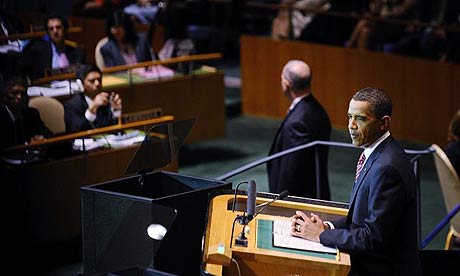
Barack Obama speaks at the UN general assembly in New York. Photograph: Jeff Zelevansky/Getty

Mr President, Mr Secretary-General, fellow delegates, ladies and gentleman: it is my honour to address you for the first time as the forty-fourth president of the United States. I come before you humbled by the responsibility that the American people have placed upon me; mindful of the enormous challenges of our moment in history; and determined to act boldly and collectively on behalf of justice and prosperity at home and abroad.

I have been in office for just nine months, though some days it seems a lot longer. I am well aware of the expectations that accompany my presidency around the world. These expectations are not about me.

Rather, they are rooted - I believe - in a discontent with a status quo that has allowed us to be increasingly defined by our differences, and outpaced by our problems. But they are also rooted in hope – the hope that real change is possible, and the hope that America will be a leader in bringing about such change.

I took office at a time when many around the world had come to view America with scepticism and distrust. Part of this was due to misperceptions and misinformation about my country. Part of this was due to opposition to specific policies, and a belief that on certain critical issues, America has acted unilaterally, without regard for the interests of others. This has fed an almost reflexive anti-Americanism, which too often has served as an excuse for our collective inaction.

Like all of you, my responsibility is to act in the interest of my nation and my people, and I will never apologise for defending those interests. But it is my deeply held belief that in the year 2009 - more than at any point in human history - the interests of nations and peoples are shared.

The religious convictions that we hold in our hearts can forge new bonds among people, or tear us apart. The technology we harness can light the path to peace, or forever darken it. The energy we use can sustain our planet, or destroy it. What happens to the hope of a single child - anywhere - can enrich our world, or impoverish it.

In this hall, we come from many places, but we share a common future. No longer do we have the luxury of indulging our differences to the exclusion of the work that we must do together. I have carried this message from London to Ankara; from Port of Spain to Moscow; from Accra to Cairo; and it's what I will speak about today. Because the time has come for the world to move in a new direction. We must embrace a new era of engagement based on mutual interests and mutual respect, and our work must begin now.

We know the future will be forged by deeds and not simply words. Speeches alone will not solve our problems - it will take persistent action. So for those who question the character and cause of my nation, I ask you to look at the concrete actions that we have taken in just nine months.

On my first day in office, I prohibited - without exception or equivocation - the use of torture by the United States of America. I ordered the prison at Guantánamo Bay closed, and we are doing the hard work of forging a framework to combat extremism within the rule of law. Every nation must know: America will live its values, and we will lead by example.

We have set a clear and focused goal: to work with all members of this body to disrupt, dismantle, and defeat al-Qaida and its extremist allies - a network that has killed thousands of people of many faiths and nations, and that plotted to blow up this very building. In Afghanistan and Pakistan, we - and many nations here - are helping those governments develop the capacity to take the lead in this effort, while working to advance opportunity and security for their people.

In Iraq, we are responsibly ending a war. We have removed American combat brigades from Iraqi cities, and set a deadline of next August to remove all of our combat brigades from Iraqi territory. And I have made clear that we will help Iraqis transition to full responsibility for their future, and keep our commitment to remove all American troops by the end of 2011.

I have outlined a comprehensive agenda to seek the goal of a world without nuclear weapons. In Moscow, the United States and Russia announced that we would pursue substantial reductions in our strategic warheads and launchers. At the conference on disarmament, we agreed on a work plan to negotiate an end to the production of fissile materials for nuclear weapons. And this week, my secretary of State will become the first senior American representative to the annual members conference of the comprehensive test ban treaty.

Upon taking office, I appointed a special envoy for Middle East peace, and America has worked steadily and aggressively to advance the cause of two states - Israel and Palestine - in which peace and security take root, and the rights of both Israelis and Palestinians are respected.

To confront climate change, we have invested $80bn in clean energy. We have substantially increased our fuel-efficiency standards. We have provided new incentives for conservation, launched an energy partnership across the Americas, and moved from a bystander to a leader in international climate negotiations.

To overcome an economic crisis that touches every corner of the world, we worked with the G20 nations to forge a coordinated international response of over two trillion dollars in stimulus to bring the global economy back from the brink. We mobilised resources that helped prevent the crisis from spreading further to developing countries. And we joined with others to launch a $20bn global food security initiative that will lend a hand to those who need it most, and help them build their own capacity.

We have also re-engaged the United Nations. We have paid our bills. We have joined the Human Rights Council. We have signed the convention on the rights of persons with disabilities. We have fully embraced the millennium development goals. And we address our priorities here, in this institution - for instance, through the security council meeting that I will chair tomorrow on nuclear non proliferation and disarmament, and through the issues that I will discuss today.

This is what we have done. But this is just a beginning. Some of our actions have yielded progress. Some have laid the groundwork for progress in the future. But make no mistake: this cannot be solely America's endeavour. Those who used to chastise America for acting alone in the world cannot now stand by and wait for America to solve the world's problems alone. We have sought - in word and deed - a new era of engagement with the world. Now is the time for all of us to
take our share of responsibility for a global response to global
challenges.

If we are honest with ourselves, we need to admit that we are not living up to that responsibility. Consider the course that we are on if we fail to confront the status quo. Extremists sowing terror in pockets of the world. Protracted conflicts that grind on and on.

Genocide and mass atrocities. More and more nations with nuclear weapons. Melting ice caps and ravaged populations. Persistent poverty and pandemic disease. I say this not to sow fear, but to state a fact: the magnitude of our challenges has yet to be met by the measure of our action.

This body was founded on the belief that the nations of the world could solve their problems together. Franklin Roosevelt, who died before he could see his vision for this institution become a reality, put it this way - and I quote: "The structure of world peace cannot be the work of one man, or one party, or one nation. It cannot be a peace of large nations - or of small nations. It must be a peace which rests on the cooperative effort of the whole world."

The cooperative effort of the whole world. Those words ring even more true today, when it is not simply peace - but our very health and prosperity that we hold in common. Yet I also know that this body is made up of sovereign states. And sadly, but not surprisingly, this body has often become a forum for sowing discord instead of forging common ground; a venue for playing politics and exploiting grievances rather than solving problems. After all, it is easy to walk up to this podium and to point fingers and stoke division. Nothing is easier than blaming others for our troubles, and absolving ourselves of responsibility for our choices and our actions. Anyone can do that.

Responsibility and leadership in the 21st century demand more. In an era when our destiny is shared, power is no longer a zero sum game. No one nation can or should try to dominate another nation. No world order that elevates one nation or group of people over another will succeed. No balance of power among nations will hold. The traditional division between nations of the south and north makes no sense in an interconnected world. Nor do alignments of nations rooted in the cleavages of a long gone cold war.

The time has come to realise that the old habits and arguments are irrelevant to the challenges faced by our people. They lead nations to act in opposition to the very goals that they claim to pursue, and to vote - often in this body - against the interests of their own people.

They build up walls between us and the future that our people seek, and the time has come for those walls to come down. Together, we must build new coalitions that bridge old divides - coalitions of different faiths and creeds; of north and south, east and west; black, white, and brown.

The choice is ours. We can be remembered as a generation that chose to drag the arguments of the 20th century into the 21st; that put off hard choices, refused to look ahead, and failed to keep pace because we defined ourselves by what we were against instead of what we were for. Or, we can be a generation that chooses to see the shoreline beyond the rough waters ahead; that comes together to serve the common interests of human beings, and finally gives meaning to the promise embedded in the name given to this institution: the United Nations.

That is the future America wants - a future of peace and prosperity that we can only reach if we recognise that all nations have rights, but all nations have responsibilities as well. That is the bargain that makes this work. That must be the guiding principle of international cooperation.

Today, I put forward four pillars that are fundamental to the future that we want for our children: non-proliferation and disarmament; the promotion of peace and security; the preservation of our planet; and a global economy that advances opportunity for all people.

First, we must stop the spread of nuclear weapons, and seek the goal of a world without them.

This institution was founded at the dawn of the atomic age, in part because man's capacity to kill had to be contained. For decades, we averted disaster, even under the shadow of a superpower stand-off. But today, the threat of proliferation is growing in scope and complexity. If we fail to act, we will invite nuclear arms races in every region, and the prospect of wars and acts of terror on a scale that we can hardly imagine.

A fragile consensus stands in the way of this frightening outcome - the basic bargain that shapes the nuclear non proliferation treaty. It says that all nations have the right to peaceful nuclear energy; that nations with nuclear weapons have the responsibility to move toward disarmament; and those without them have the responsibility to forsake them. The next twelve months could be pivotal in determining whether this compact will be strengthened or will slowly dissolve.

America will keep our end of the bargain. We will pursue a new agreement with Russia to substantially reduce our strategic warheads and launchers. We will move forward with ratification of the test ban treaty, and work with others to bring the Treaty into force so that nuclear testing is permanently prohibited. We will complete a nuclear posture review that opens the door to deeper cuts, and reduces the role of nuclear weapons. And we will call upon countries to begin negotiations in January on a treaty to end the production of fissile material for weapons.

I will also host a summit next April that reaffirms each nation's responsibility to secure nuclear material on its territory, and to help those who can't - because we must never allow a single nuclear device to fall into the hands of a violent extremist. And we will work to strengthen the institutions and initiatives that combat nuclear smuggling and theft.

All of this must support efforts to strengthen the NPT. Those nations that refuse to live up to their obligations must face consequences. This is not about singling out individual nations - it is about standing up for the rights of all nations that do live up to their responsibilities. Because a world in which IAEA inspections are avoided and the United Nation's demands are ignored will leave all people less safe, and all nations less secure.

In their actions to date, the governments of North Korea and Iran threaten to take us down this dangerous slope. We respect their rights as members of the community of nations. I am committed to diplomacy that opens a path to greater prosperity and a more secure peace for both nations if they live up to their obligations.

But if the governments of Iran and North Korea choose to ignore international standards; if they put the pursuit of nuclear weapons ahead of regional stability and the security and opportunity of their own people; if they are oblivious to the dangers of escalating nuclear arms races in both East Asia and the Middle East - then they must be held accountable. The world must stand together to demonstrate that international law is not an empty promise, and that Treaties will be enforced. We must insist that the future not belong to fear.

That brings me to the second pillar for our future: the pursuit of peace.

The United Nations was born of the belief that the people of the world can live their lives, raise their families, and resolve their differences peacefully. And yet we know that in too many parts of the world, this ideal remains an abstraction. We can either accept that outcome as inevitable, and tolerate constant and crippling conflict.

Or we can recognise that the yearning for peace is universal, and reassert our resolve to end conflicts around the world.

That effort must begin with an unshakeable determination that the murder of innocent men, women and children will never be tolerated. On this, there can be no dispute. The violent extremists who promote conflict by distorting faith have discredited and isolated themselves. They offer nothing but hatred and destruction. In confronting them, America will forge lasting partnerships to target terrorists, share intelligence, coordinate law enforcement, and protect our people. We will permit no safe-haven for al-Qaida to launch attacks from Afghanistan or any other nation. We will stand by our friends on the front lines, as we and many nations will do in pledging support for the Pakistani people tomorrow. And we will pursue positive engagement that builds bridges among faiths, and new partnerships for opportunity.

But our efforts to promote peace cannot be limited to defeating violent extremists. For the most powerful weapon in our arsenal is the hope of human beings - the belief that the future belongs to those who build, not destroy; the confidence that conflicts can end, and a new day begin.

That is why we will strengthen our support for effective peacekeeping, while energising our efforts to prevent conflicts before they take hold. We will pursue a lasting peace in Sudan through support for the people of Darfur, and the implementation of the comprehensive peace agreement, so that we secure the peace that the Sudanese people deserve. And in countries ravaged by violence - from Haiti to Congo to East Timor - we will work with the UN and other partners to support an enduring peace.

I will also continue to seek a just and lasting peace between Israel, Palestine, and the Arab world. Yesterday, I had a constructive meeting with Prime Minister Netanyahu and President Abbas. We have made some progress. Palestinians have strengthened their efforts on security. Israelis have facilitated greater freedom of movement for the Palestinians. As a result of these efforts by both sides, the economy in the West Bank has begun to grow. But more progress is needed. We continue to call on Palestinians to end incitement against Israel, and we continue to emphasise that America does not accept the legitimacy of continued Israeli settlements.

The time has come to relaunch negotiations - without preconditions - that address the permanent-status issues: security for Israelis and Palestinians; borders, refugees and Jerusalem. The goal is clear: two states living side by side in peace and security - a Jewish state of Israel, with true security for all Israelis; and a viable, independent Palestinian state with contiguous territory that ends the occupation that began in 1967, and realises the potential of the Palestinian people. As we pursue this goal, we will also pursue peace between Israel and Lebanon, Israel and Syria, and a broader peace between Israel and its many neighbours. In pursuit of that goal, we will develop regional initiatives with multilateral participation, alongside bilateral negotiations.

I am not naive. I know this will be difficult. But all of us must decide whether we are serious about peace, or whether we only lend it lip-service. To break the old patterns - to break the cycle of insecurity and despair - all of us must say publicly what we would acknowledge in private. The United States does Israel no favours when we fail to couple an unwavering commitment to its security with an insistence that Israel respect the legitimate claims and rights of the Palestinians. And nations within this body do the Palestinians no favours when they choose vitriolic attacks over a constructive willingness to recognise Israel's legitimacy, and its right to exist in peace and security.

We must remember that the greatest price of this conflict is not paid by us. It is paid by the Israeli girl in Sderot who closes her eyes in fear that a rocket will take her life in the night. It is paid by the Palestinian boy in Gaza who has no clean water and no country to call his own. These are God's children. And after all of the politics and all of the posturing, this is about the right of every human being to live with dignity and security. That is a lesson embedded in the three great faiths that call one small slice of Earth the Holy Land. And that is why - even though there will be setbacks, and false starts, and tough days - I will not waiver in my pursuit of peace.

Third, we must recognise that in the 21st century, there will be no peace unless we make take responsibility for the preservation of our planet.

The danger posed by climate change cannot be denied, and our responsibility to meet it must not be deferred. If we continue down our current course, every member of this assembly will see irreversible changes within their borders. Our efforts to end conflicts will be eclipsed by wars over refugees and resources.

Development will be devastated by drought and famine. Land that human beings have lived on for millennia will disappear. Future generations will look back and wonder why we refused to act - why we failed to pass on intact the environment that was our inheritance.

That is why the days when America dragged its feet on this issue are over. We will move forward with investments to transform our energy economy, while providing incentives to make clean energy the profitable kind of energy. We will press ahead with deep cuts in emissions to reach the goals that we set for 2020, and eventually 2050. We will continue to promote renewable energy and efficiency - and share new technologies - with countries around the world. And we will seize every opportunity for progress to address this threat in a cooperative effort with the whole world.

Those wealthy nations that did so much to damage the environment in the 20th century must accept our obligation to lead. But responsibility does not end there. While we must acknowledge the need for differentiated responses, any effort to curb carbon emissions must include the fast-growing carbon emitters who can do more to reduce their air pollution without inhibiting growth. And any effort that fails to help the poorest nations both adapt to the problems that climate change has already wrought - and travel a path of clean development - will not work.

It is hard to change something as fundamental as how we use energy. It's even harder to do so in the midst of a global recession. Certainly, it will be tempting to sit back and wait for others to move first. But we cannot make this journey unless we all move forward together. As we head into Copenhagen, let us resolve to focus on what each of us can do for the sake of our common future.

This leads me to the final pillar that must fortify our future: a global economy that advances opportunity for all people.

The world is still recovering from the worst economic crisis since the great depression. In America, we see the engine of growth beginning to churn, yet many still struggle to find a job or pay their bills. Across the globe, we find promising signs, yet little certainty about what lies ahead. And far too many people in far too many places live through the daily crises that challenge our common humanity – the despair of an empty stomach; the thirst brought on by dwindling water; the injustice of a child dying from a treatable disease, or a mother losing her life as she gives birth.

In Pittsburgh, we will work with the world's largest economies to chart a course for growth that is balanced and sustained. That means vigilance to ensure that we do not let up until our people are back to work. That means taking steps to rekindle demand, so that a global recovery can be sustained. And that means setting new rules of the road and strengthening regulation for all financial centres, so that we put an end to the greed, excess and abuse that led us into disaster, and prevent a crisis like this from ever happening again.

At a time of such interdependence, we have a moral and pragmatic interest in broader questions of development. And so we will continue our historic effort to help people feed themselves. We have set aside $63bn to carry forward the fight against HIV/Aids; to end deaths from tuberculosis and malaria; to eradicate polio; and to strengthen public health systems. We are joining with other countries to contribute H1N1 vaccines to the World Health Organisation. We will integrate more economies into a system of global trade. We will support the Millennium Development Goals, and approach next year's summit with a global plan to make them a reality. And we will set our sights on the eradication of extreme poverty in our time.

Now is the time for all of us to do our part. Growth will not be sustained or shared unless all nations embrace their responsibility. Wealthy nations must open their markets to more goods and extend a hand to those with less, while reforming international institutions to give more nations a greater voice. Developing nations must root out the corruption that is an obstacle to progress - for opportunity cannot thrive where individuals are oppressed and business have to pay bribes. That's why we will support honest police and independent judges; civil society and a vibrant private sector. Our goal is simple: a global economy in which growth is sustained, and opportunity is available to all.

The changes that I have spoken about today will not be easy to make. And they will not be realised simply by leaders like us coming together in forums like this. For as in any assembly of members, real change can only come through the people we represent. That is why we must do the hard work to lay the groundwork for progress in our own capitals. That is where we will build the consensus to end conflicts and to harness technology for peaceful purposes; to change the way we use energy, and to promote growth that can be sustained and shared.

I believe that the people of the world want this future for their children. And that is why we must champion those principles which ensure that governments reflect the will of the people. These principles cannot be afterthoughts - democracy and human rights are essential to achieving each of the goals that I have discussed today.

Because governments of the people and by the people are more likely to act in the broader interests of their own people, rather than the narrow interest of those in power.

The test of our leadership will not be the degree to which we feed the fears and old hatreds of our people. True leadership will not be measured by the ability to muzzle dissent, or to intimidate and harass political opponents at home. The people of the world want change. They will not long tolerate those who are on the wrong side of history.

This assembly's Charter commits each of us, and I quote - "to reaffirm faith in fundamental human rights, in the dignity and worth of the
human person, in the equal rights of men and women."

Among those rights is the freedom to speak your mind and worship as you please; the promise of equality of the races, and the opportunity for women and girls to pursue their own potential; the ability of citizens to have a say in how you are governed, and to have confidence in the administration of justice. For just as no nation should be forced to accept the tyranny of another nation, no individual should be forced to accept the tyranny of their own government.

As an African-American, I will never forget that I would not be here today without the steady pursuit of a more perfect union in my country. That guides my belief that no matter how dark the day may seem, transformative change can be forged by those who choose the side of justice. And I pledge that America will always stand with those who stand up for their dignity and their rights - for the student who seeks to learn; the voter who demands to be heard; the innocent who longs to be free; and the oppressed who yearns to be equal.

Democracy cannot be imposed on any nation from the outside. Each society must search for its own path, and no path is perfect. Each country will pursue a path rooted in the culture of its people, and - in the past - America has too often been selective in its promotion of democracy. But that does not weaken our commitment, it only reinforces it. There are basic principles that are universal; there are certain truths which are self evident - and the United States of America will never waiver in our efforts to stand up for the right of people everywhere to determine their own destiny.

Sixty-five years ago, a weary Franklin Roosevelt spoke to the American people in his fourth and final inaugural address. After years of war, he sought to sum up the lessons that could be drawn from the terrible suffering and enormous sacrifice that had taken place. "We have learned," he said, "to be citizens of the world, members of the human community".

The United Nations was built by men and women like Roosevelt from every corner of the world - from Africa and Asia; form Europe to the Americas. These architects of international cooperation had an idealism that was anything but naive - it was rooted in the hard-earned lessons of war, and the wisdom that nations could advance their interests by acting together instead of splitting apart.

Now it falls to us - for this institution will be what we make of it. The United Nations does extraordinary good around the world in feeding the hungry, caring for the sick, and mending places that have been broken. But it also struggles to enforce its will, and to live up to the ideals of its founding.

I believe that those imperfections are not a reason to walk away from this institution - they are a calling to redouble our efforts. The United Nations can either be a place where we bicker about outdated grievances, or forge common ground; a place where we focus on what drives us apart, or what brings us together; a place where we indulge tyranny, or a source of moral authority. In short, the United Nations can be an institution that is disconnected from what matters in the lives of our citizens, or it can be indispensable in advancing the interests of the people we serve. Link...

More stories coming soon...


D I S C L A I M E R :

Clarification: All of the contents provided on worldnewskhi.blogspot.com are hyperlinks. NO story are created or produced by us. Our job here is to provide simple hyperlinks and easy guidance for users to find stories on single page. We DO NOT create News here! If you find any content that is violating the copyright law, please send an email to naveed4pkk@gmail.com